Does it fit my specific trim level?
Trim level alone does not confirm fitment; you need the VIN, model year, and any option codes tied to that part. Buying on trim only can leave you with a wrong part, wasted return shipping, and installation delays. This guide gives a simple decision tree for separating trim, package, and option-code fitment before you order.
What trim level means
Trim level is the model-grade label on a vehicle. It marks equipment changes, appearance changes, and sometimes engine, transmission, brake, or wheel differences. The same base model can use different parts across trims, so the trim badge alone is not enough for parts buying.
Trim level vs model grade
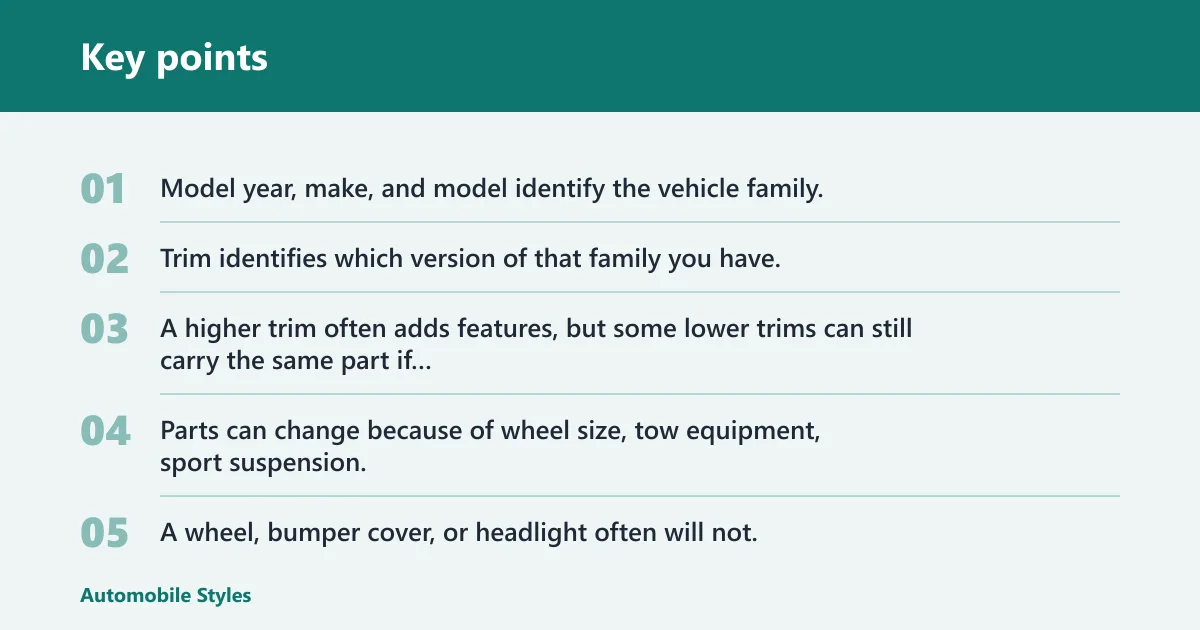
Model year, make, and model identify the vehicle family. Trim identifies which version of that family you have. A higher trim often adds features, but some lower trims can still carry the same part if the factory package or option code matches.
Why trim changes parts fitment
Parts can change because of wheel size, tow equipment, sport suspension, lighting package, or a different brake setup. A grille may swap cleanly across trims. A wheel, bumper cover, or headlight often will not.
Say your sedan has an “S” trim with 17-inch wheels and base brakes, while the sport trim uses 19-inch wheels and larger front rotors. The body shell may look similar, but the wheel, caliper, and some splash shield parts can differ enough to make a direct swap fail.
Trim, package, or option code?
Trim is only one layer. Package and factory option code can change the part list even when the trim name stays the same. VIN decoding can confirm the vehicle identity, but it does not always expose every equipment change that matters for fitment.
What the VIN can confirm
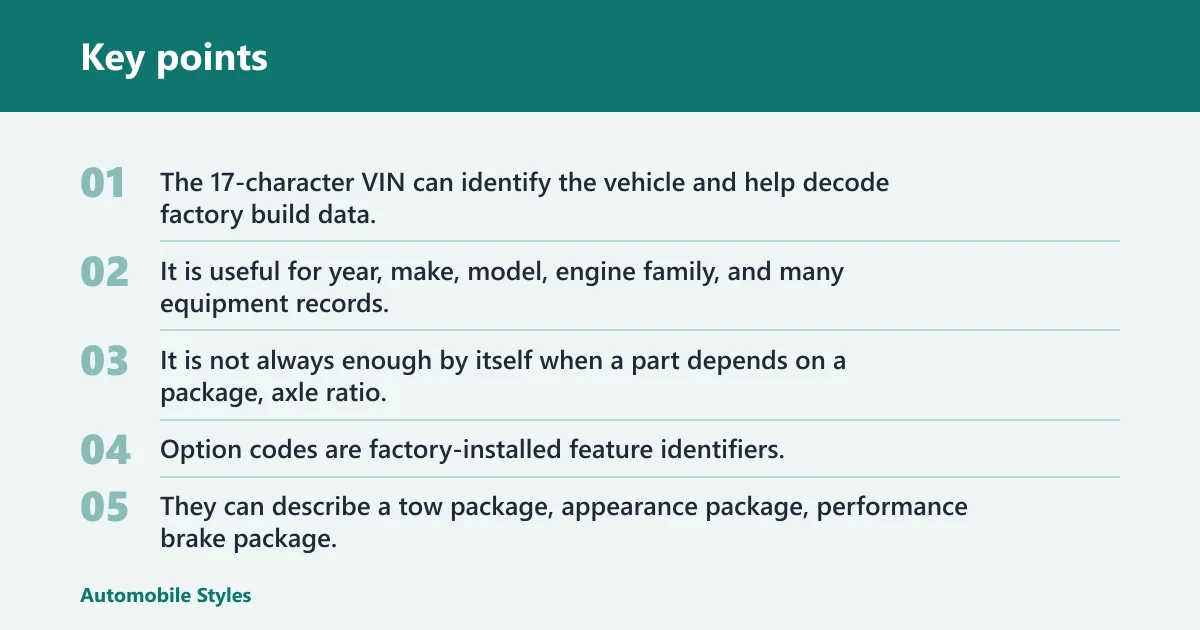
The 17-character VIN can identify the vehicle and help decode factory build data. It is useful for year, make, model, engine family, and many equipment records. It is not always enough by itself when a part depends on a package, axle ratio, brake code, or lighting code.
Why option codes can override trim assumptions
Option codes are factory-installed feature identifiers. They can describe a tow package, appearance package, performance brake package, or lighting group that changes the exact part required. Two vehicles with the same trim can need different parts if their codes differ.
Where OEM catalogs separate submodels and packages
OEM fitment catalogs often split a listing by submodel, engine, drivetrain, wheel size, or package. Notes and exclusions matter. If a catalog says “except sport suspension” or “with 19-inch wheels,” that is more important than the broad trim name.
Suppose an OEM catalog lists one headlight for a trim, then adds an exclusion for vehicles with auto-leveling lamps. That note can override the trim filter. The part may fit the trim on paper, but not the exact build.
Does it fit my specific trim level?
Start with the trim, then verify the details that move the part. If the item affects body shape, lighting, wheel clearance, or brake clearance, check the VIN, option code, OEM part number, and listing notes before buying. Trim alone is only a first filter.
A simple decision tree
- Confirm year, make, model, and trim from the VIN or build sheet.
- Check whether the part is trim-sensitive: bumper, grille, lamp, wheel, brake, or interior trim.
- Look for an option code or package tied to that part.
- Match the OEM part number, including any supersession note.
- Read the listing note for exclusions, submodels, and production-date limits.
- If any step conflicts, verify first instead of buying.
When to stop and verify first
Stop when the listing says “except,” “with,” “without,” “non-sport,” “tow package,” or “premium lighting.” Stop again if the seller gives only a trim name and no part number. When the fitment note is vague, the cost of a return can be higher than the time it takes to confirm the build data.
Trim fitment checklist
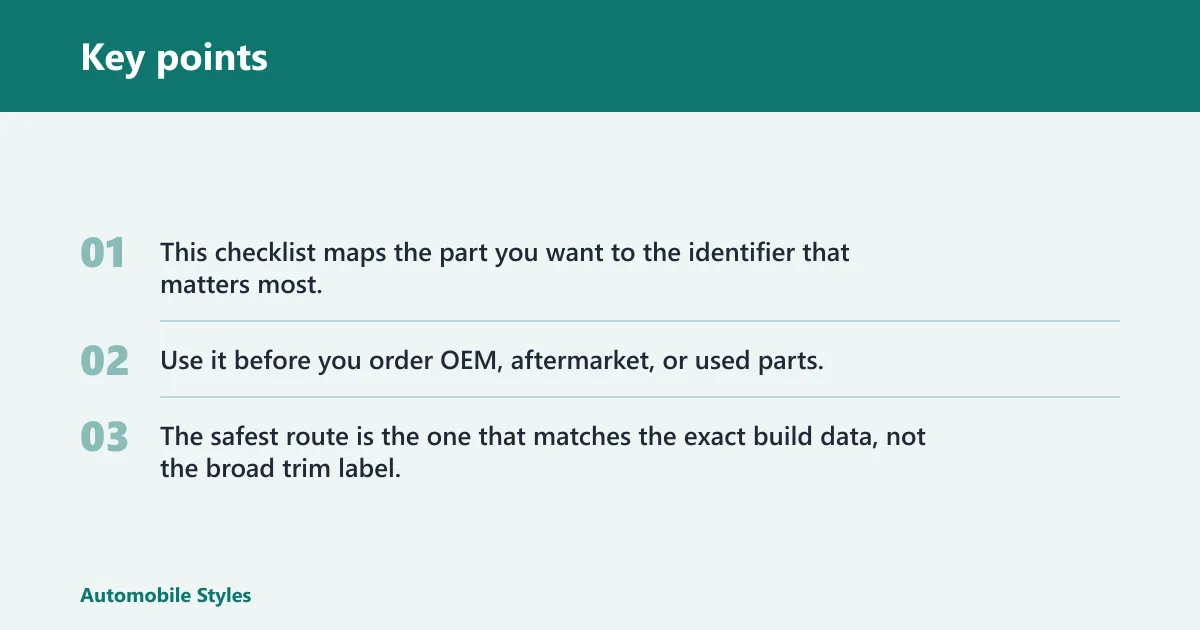
This checklist maps the part you want to the identifier that matters most. Use it before you order OEM, aftermarket, or used parts. The safest route is the one that matches the exact build data, not the broad trim label.
| Part category | VIN | Option code | OEM part number | Build sheet line item | Listing note | Safe to buy / verify first / avoid |
|---|---|---|---|---|---|---|
| Bumpers | Useful for model year and bumper family | Needed for parking sensors, tow hooks, appearance package | Must match exact fascia number and revision | Look for front camera, sensors, fog lamp cutouts | Check for “with sensor holes,” “sport,” or “without tow package” | Verify first |
| Grilles | Confirms body style and front-end family | Needed for emblem, radar, adaptive cruise, trim appearance | Must match grille insert and surround number | Check grille type, emblem size, radar opening | Watch for “upper grille only,” “non-adaptive,” or “camera-equipped” | Verify first |
| Headlights | Useful, but rarely enough alone | Needed for LED, HID, auto-leveling, cornering lamps | Critical for lamp type and connector version | Check lamp technology and leveling system | Look for “halogen only,” “LED,” “AFS,” or “adaptive” | Verify first |
| Wheels | Confirms model, brake package, and axle family | Needed for sport package or brake clearance | Must match diameter, offset, bolt pattern, load rating | Check wheel size and brake package line | Watch for “fits all trims” if brake package is not listed | Verify first |
| Brakes | Useful for brake family and rotor size | Needed for performance, tow, or heavy-duty package | Must match caliper and rotor part numbers | Check rotor diameter and caliper code | Look for exclusions by wheel size or sport trim | Verify first |
| Interior trim | Confirms cabin family and seat layout | Needed for seat type, stitching, memory, heated features | Must match bezel, switch panel, or trim piece revision | Check console, door trim, seat trim line | Read for left-hand or right-hand, with or without switches | Safe to buy |
Which parts are most trim-specific?
Bumpers, grilles, headlights, wheels, brakes, and interior pieces change often enough that trim-only shopping is risky. These parts can depend on sensor openings, lamp technology, wheel diameter, or seat and console equipment. One trim name can cover more than one factory build.
Bumpers and grilles
Front and rear bumper covers may vary by fog lamps, parking sensors, tow hooks, exhaust cutouts, or styling package. Grilles can change for emblem size, radar opening, camera placement, or sport appearance. A part that looks close can still miss the mounting points.
Headlights and tail lights
Lighting parts often change with halogen, HID, LED, matrix, adaptive, or auto-leveling equipment. Tail lamps can also differ by trunk lid style, hatch style, or lighting package. Check the connector, mounting tabs, and lamp technology, not just the outer shape.
Wheels and brakes
Wheel fitment is tied to bolt pattern, offset, center bore, and brake clearance. Performance or tow packages can use larger rotors and calipers that need larger wheels. A wheel may bolt on and still not clear the brake package.
Interior trim pieces
Interior parts can vary by seat style, console layout, drive mode buttons, heated seat switches, and camera or display options. These pieces are often less risky than exterior parts, but the switch cutouts and bezel shape still need a part-number match.
How to read fitment notes
Fitment notes are where sellers tell you what the trim filter does not. Read the words around the compatibility line, then compare them to the vehicle build. If the note narrows the part by package, light type, or wheel size, treat that note as part of the fitment rule.
Words that signal exclusions
- Except means a specific build is excluded.
- With means an added feature is required.
- Without means a feature must be absent.
- Non-sport or sport points to trim-linked differences.
- Tow package, premium lighting, and performance brake package mean the trim label is incomplete.
Aftermarket listing risks
Aftermarket listings may use broad compatibility claims and small-print exclusions. They can also group several factory configurations under one headline. Check for a return policy that still works if the part arrives and the mounting points do not match. A low-priced listing is not a fitment guarantee.
Used part listing checks
Used parts listings need extra care because supersessions, production changes, and midyear updates can change the correct part number. Compare the donor vehicle’s trim, options, and production date if the seller provides them. Photos help, but the printed part number is better.
Does it fit my specific trim?
Trim can be enough only when the part is not tied to package equipment, lighting, brake size, or a production change. If the OEM part number matches and the listing note has no exclusions, trim may be sufficient. If any of those details differ, you need more than the trim label.
When VIN is enough
VIN decoding is often enough for parts tied to the base vehicle family, such as some interior trim pieces or basic mechanical items. It is less reliable for parts influenced by appearance packages, brake packages, or lighting upgrades. The VIN is a starting point, not the finish line.
When you need a build sheet
Use the build sheet when the vehicle has a sport package, tow package, appearance package, upgraded lighting, or performance brakes. Those codes can change the exact part even if the trim badge stays the same. The build sheet also helps when the seller cannot explain a vague listing note.
When to contact the seller or dealer
Contact the seller or dealer when the listing says “fits all trims” but also mentions exclusions, a production date split, or an equipment requirement. Ask for the OEM part number and the option code match. If they cannot provide either one, treat the fitment as unconfirmed.
Frequently asked questions
What is the trim level on a vehicle?
Trim level is the vehicle’s model-grade label. It groups equipment, appearance, and sometimes mechanical differences under one name. That label helps narrow parts, but it does not replace the build sheet or the exact option code when a part is trim-sensitive.
How do I determine my vehicle trim level?
Check the VIN decode, window sticker, build sheet, owner paperwork, or the manufacturer’s vehicle information label if available. Match the year, make, model, and trim before you compare parts. Then verify whether the vehicle has packages or options that change the part.
What trim level is my car?
Your car’s trim level is usually printed in the seller listing, on the original window sticker, or in a VIN-based build record. If the trim is unclear, look for package codes and equipment notes, because those can change the correct part even when the badge looks simple.
Does it cover all trim levels?
Not always. A part listing may say it fits several trims and still exclude one brake package, one lighting package, or one production range. Read the note and check the exact part number. “All trims” can still hide exceptions.
What should I verify when trim fitment is unclear?
Verify the VIN, option code, OEM part number, build sheet line item, and listing note. If those five items do not line up, stop and ask for a dealer lookup or a seller confirmation in writing. That is the cleanest way to avoid a wrong part.