Fog lights vs low beams: When should you use each?
Use low beams for normal night driving. Add front fog lights only when fog, heavy spray, snow, or mist cuts forward visibility close to the road. Keep high beams off in those conditions. Wrong beam choice can throw light back at you, cut contrast, and blind other drivers. This guide gives a simple use-this-not-that matrix for fog, rain, snow, tunnels, and clear-night driving.
| Decision factor | Fog lights | Low beams | Winner |
|---|---|---|---|
| Best use case | Low-visibility weather close to the road | Normal night driving and mixed traffic | low beams |
| Beam shape | Wide horizontal beam with a low, flat pattern | Downward, forward-aimed beam with a sharp upper cutoff | tie |
| Glare control | Good when aimed correctly and used low | Better all-around glare control for other drivers | low beams |
| Fog, spray, and snow | Helpful when visibility drops below 100 meters | Usually the safer default in rain and snow | tie |
| Traffic etiquette | Can annoy others or be illegal when conditions are clear | Standard choice for oncoming and following traffic | low beams |
| Range | Short-range, near-road light | About 40 to 50 meters ahead, with low-beam headlights giving off less light, up to 200 to 300 feet | low beams |
What each light
Fog lights are auxiliary front lights mounted low near the bumper. Their wide horizontal beam is meant for short-range visibility close to the pavement. Low beams are the standard headlight mode, angled downward and forward, and they remain the default choice for most night driving. High beams belong on dark, empty roads only.
The core rule is simple: low beams first, fog lights as a supplement when weather and road shape make short-range light more useful than distance. If you can still read the road far enough ahead to match your speed, low beams usually stay in charge. If the view turns into a white wall, fog lights may help.
How the two beams differ
Fog lights sit low, usually near the bumper line, so their beam starts below much of the moisture in the air. Low beams start higher and reach farther ahead. In practice, fog lights are built to light the road edge and lane immediately in front of the car, while low beams are built for normal forward driving.
Front fog lights and rear fog lights are different tools. Front fog lights help you see the road. Rear fog lights can help other drivers spot your vehicle from behind in poor visibility. That rear light should stay off when it is not needed, because it can be harsh to traffic following you.
Where high beams fit
High beams are the long-range headlight mode. They can project 350 to 500 feet in normal conditions, and they are the better choice on dark highways with no traffic. In fog, heavy rain, or snow, though, that extra reach becomes a problem because the light reflects back at you.
High beams can reach up to 100 meters or more, but that distance does not help when the air is full of droplets or flakes. The beam bounces off those particles, creates glare, and can leave you staring into a bright haze instead of a clear road.
Fog lights decision matrix
| Scenario | Light choice | Why | Main glare risk |
|---|---|---|---|
| Dense fog | Low beams plus front fog lights | Short-range light helps when visibility drops below 100 meters | Backscatter from droplets creates a white wall effect |
| Light fog | Low beams | Fog lights help only if the fog is thick enough to cut forward view close to the road | Extra fog-light glare if the lamps are mis-aimed |
| Heavy rain | Low beams | Low beams are the safer default; fog lights can add near-road help if spray is severe | Reflection from water on the road and mist in the spray |
| Drizzle | Low beams | Visibility is usually still good enough for standard headlight use | Light scatter is modest, but fog lights can add unnecessary glare |
| Snow | Low beams plus front fog lights | Fog lights can help in falling or blowing snow when forward visibility is short | Snowflakes reflect light back toward the driver |
| Mist | Low beams | Use fog lights only when the mist is thick enough to limit sight distance | Minor backscatter if the beam is too high |
| City night | Low beams | Traffic, signs, and street lighting make fog lights unnecessary | Other drivers can be dazzled by extra front light |
| Rural night | High beams, then low beams for traffic | High beams are the better choice on dark highways and empty roads | High-beam glare for oncoming or leading traffic |
| Tunnel | Low beams | Lighting is controlled and visibility changes fast at the entrance and exit | Overbright front lights can bother drivers ahead |
| Oncoming traffic | Low beams | Low beams reduce glare for other drivers | High-beam dazzle is the main risk |
| Following traffic | Low beams | Low beams are the least disruptive choice | Rear fog lights can glare through mirrors |
| Clear weather | Low beams | Fog lights are not needed and may be inappropriate in some regions | Unneeded fog lamps can annoy others and invite enforcement |
Read the matrix as a rule set, not a menu. Low beams remain the default in almost every normal case. Front fog lights enter the picture when weather, spray, or road shape compresses the useful view to the first stretch of pavement, especially below the common 100-meter guideline.
Say your commute turns into patchy fog on a two-lane road. If the fog comes and goes, low beams may be enough, because fog lights are most useful in thick fog rather than in brief gaps of haze. If the fog gets denser and the lane edge disappears, add front fog lights and keep high beams off.
A common first-timer mistake is switching on every lamp at once in rain. That looks bright from the cabin, but the reflected light can make the windshield view worse. In heavy spray, low beams remain the safe default; front fog lights are a supplement only when the spray and low cloud of mist are cutting the near field badly.
Should you use fog lights in fog?
Yes, but only as a supplement to low beams when fog is thick enough to shorten your usable sight line. The key rule is simple: low beams stay on, fog lights can help close to the road, and high beams stay off because they bounce light back at you and at other drivers.
When fog lights help
Fog lights help most in thick fog, heavy rain, blowing dust, or snow. Their wide horizontal beam stays low and flat, which reduces the amount of light that gets sent upward into suspended moisture. That lower beam pattern can make lane markings, curbs, and the road edge easier to judge at short range.
The common 100-meter guideline is useful here. If visibility is below 100 meters, fog lights may be appropriate. If you can still see farther than that, low beams usually do the job without adding the extra glare that can bother other drivers.
When low beams should stay
Low beams should stay on any time you drive. They are the standard headlight mode and they reduce glare for oncoming traffic better than high beams. In fog, rain, and snow, they are still the baseline. Fog lights do not replace them; they sit underneath them as a helper.
If the fog is only patchy, use low beams and adjust your speed first. Road type matters too. On a city street with lights and steady traffic, fog lights rarely add enough value. On a rural road with thick fog and no street lighting, the extra near-road beam can matter more.
When high beams make visibility worse
High beams are a poor choice in fog because the beam reaches into more of the moisture cloud and throws more light back toward the driver. The result is a brighter haze, not a clearer road. That same glare problem shows up in heavy rain and snow, where droplets and flakes create backscatter. (Firestonecompleteautocare)
High beams belong on dark, empty roads where long-range seeing matters more than glare control. Once you meet traffic, enter fog, or follow another vehicle closely, switch them off. The goal is contrast, not raw brightness.
Are low beams better than fog lights in rain and snow?
Yes. Low beams are the better default in rain and snow because they are designed for ordinary night driving and control glare better than high beams. Fog lights can help when the precipitation is heavy enough to shorten forward visibility, but they should sit beside low beams, not replace them.
Heavy rain versus drizzle
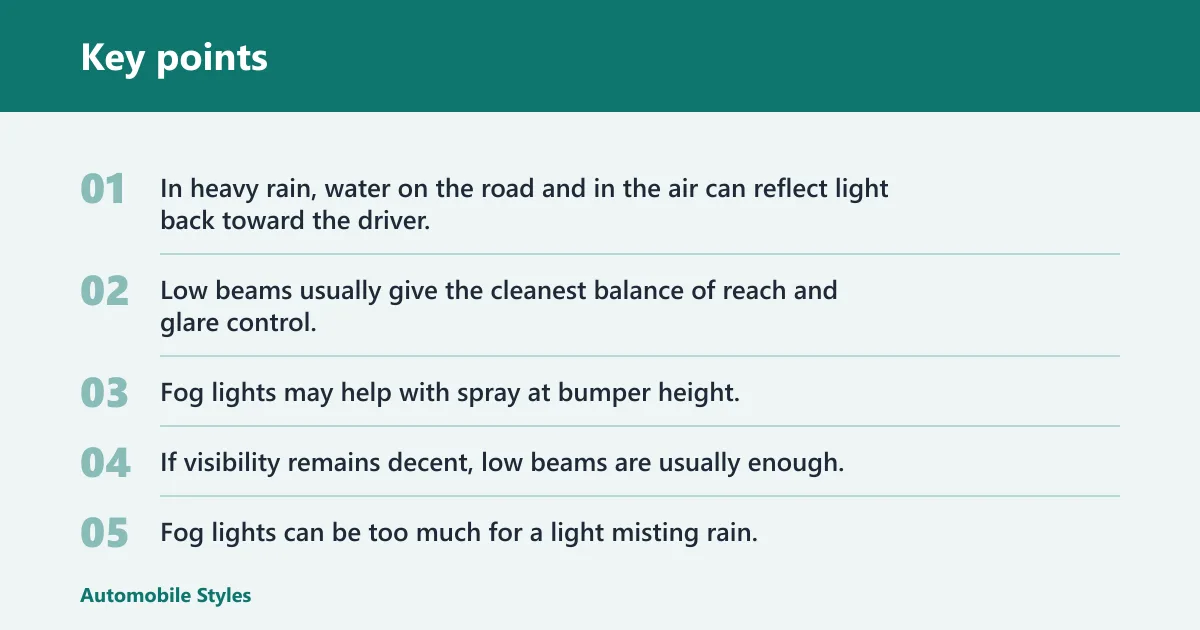
In heavy rain, water on the road and in the air can reflect light back toward the driver. Low beams usually give the cleanest balance of reach and glare control. Fog lights may help with spray at bumper height, but they are not a substitute for low beams and should not be treated as the main lamp.
Drizzle is different. If visibility remains decent, low beams are usually enough. Fog lights can be too much for a light misting rain, especially if the lamps are aimed too high or the road is already bright from surrounding traffic and shop lighting.
Snow, slush, and spray
Snow can be useful fog-light territory, especially when flakes are thick or blowing across the road. The same is true for slush spray from other vehicles. Even then, low beams stay on, because they are still the standard forward-lighting mode and they protect other drivers from unnecessary glare.
Front fog lights are the better choice when the problem is near-road contrast, not distance. Rear fog lights are different. They can be useful in very poor rear visibility, but they should be turned off once the weather eases, because following drivers do not need a bright red lamp in normal traffic.
Why beam cutoff matters
Beam cutoff is the sharp upper edge of the light pattern. A low beam with a clear cutoff keeps light where the road is and keeps it out of the eyes of oncoming traffic. Fog lights also work best when they stay low and wide, because that shape cuts down on the backscatter that creates the white wall effect.
If the cutoff is poor, the benefit drops fast. A mis-aimed fog light can throw light upward into fog, rain, or snow, which makes the air look brighter and the road less clear. Proper alignment matters as much as the bulb itself.
How beam pattern changes what you see
The beam pattern determines whether a lamp helps or hurts in poor visibility. Fog lights are built with a low, wide spread. Low beams use a downward, forward-aimed pattern with a sharp cutoff. High beams push farther out, but that reach becomes a liability when the air contains water droplets or flakes.
Wide, low fog light beam
Fog lights are meant to light the pavement and lane edges close to the car. That wide horizontal beam keeps more light below the densest part of fog or spray. It is useful because the driver needs short-range reference points when the far road disappears.
Factory fog lights and LED retrofit fog lights do not behave the same unless the housing, bulb, and aim are correct for the vehicle. Check the owner’s manual and the product listing for compatibility before assuming an LED retrofit will preserve the original beam shape.
Low-beam cutoff and glare control
Low beams are the better all-round choice because they balance range and glare control. They are angled farther ahead than fog lights, which makes them useful for normal night driving and for seeing farther down the lane. They also cut off the upper portion of the beam so less light reaches other drivers.
That cutoff matters in traffic. When another car is coming toward you, the low beam pattern is less likely to dazzle the other driver than fog lights mounted too high or high beams left on too long.
Why misaligned lights scatter upward
Misalignment changes the whole result. A fog light aimed too high sends more light into suspended moisture, where it reflects back into the driver’s line of sight. Instead of a low, flat beam, you get scattered glare and reduced contrast.
That is why aiming matters after replacement parts, body repairs, or LED retrofits. If the beam no longer sits low and wide, the lamp is doing the opposite of what it should. Follow the vehicle manual for aiming guidance, and check local laws before using fog lamps in clear weather.
Fog light legality and rear fog lights
Fog light rules vary by state, and rear fog lights can be illegal or inappropriate when they are not needed. Some regions limit front fog light use in clear weather because the extra glare can bother other drivers. Others focus on rear fog lights because those lamps can be harsh from behind and should only be used in low visibility.
Why some places restrict clear-weather use
In clear weather, fog lights often add more visual clutter than safety. A bright lamp low on the bumper can distract other drivers without improving your own view. That is why some places treat unnecessary fog-light use as improper equipment use or a lighting violation, especially when traffic is heavy.
If you drive across state lines, the rule can change. Treat fog-light use as local equipment law, not a universal habit. The owner’s manual tells you how the lamps are meant to work; state rules decide when they are allowed on public roads.
Front fog lights versus rear fog lights
Front fog lights help the driver see. Rear fog lights help other drivers see you. That distinction matters because the two lamps are not used the same way. A rear fog light that is left on after the weather clears can glare in mirrors and annoy the car behind you.
Use rear fog lights only when visibility is poor enough that the vehicle itself is hard to see. Turn them off once the condition ends. Front fog lights are less likely to cause mirror glare, but they still should not stay on in clear weather unless the vehicle manual and local rules allow it.
What to confirm in your state or owner’s manual
Confirm three things: whether front fog lights are legal for routine use, whether rear fog lights have a separate rule, and whether your lamp type is approved for your vehicle. Factory halogen fog lights and LED retrofit fog lights can behave differently, so compatibility and aim both matter.
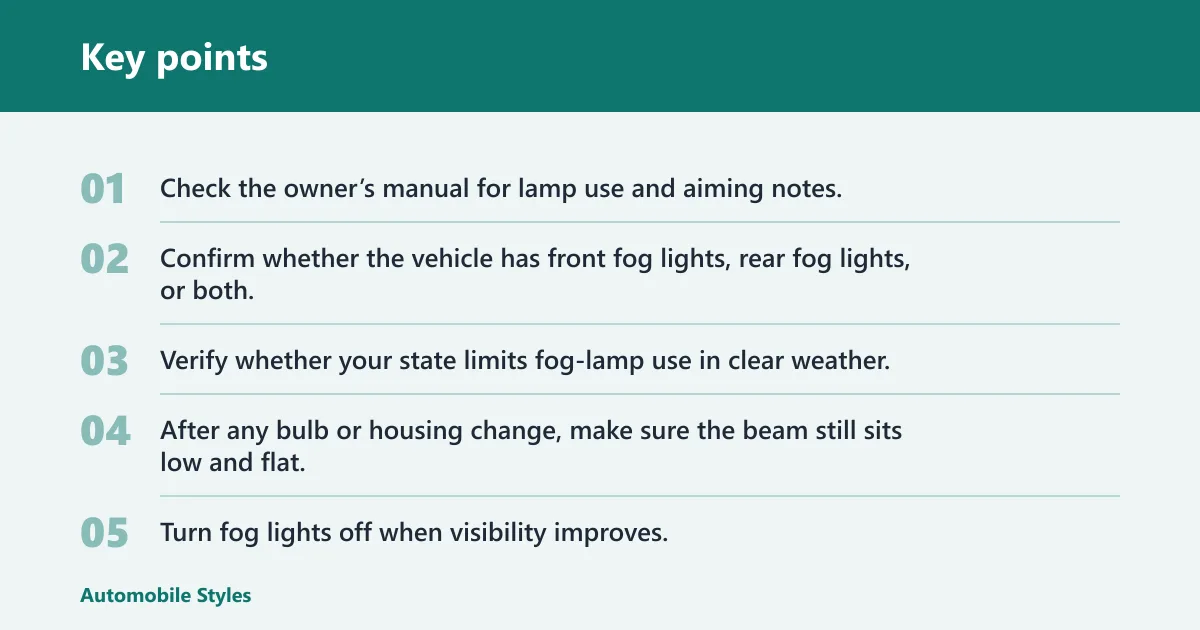
- Check the owner’s manual for lamp use and aiming notes.
- Confirm whether the vehicle has front fog lights, rear fog lights, or both.
- Verify whether your state limits fog-lamp use in clear weather.
- After any bulb or housing change, make sure the beam still sits low and flat.
- Turn fog lights off when visibility improves.
Choose fog lights if… / Choose low beams if…
Choose fog lights if visibility has dropped below 100 meters, the road is low and dark, and the problem is close-in spray, fog, snow, or mist. Choose low beams if the weather is only mild, traffic is present, or you need the most predictable glare control. Low beams stay on in both cases.
Fog lights work best as a supplement, not a replacement. Low beams are the right answer for normal night driving, city streets, tunnels, oncoming traffic, and most rain. Turn fog lights off when the air clears, when the road opens up, or when the lamps start to bother other drivers.
Frequently asked questions
Should I use fog lights or low beams in fog?
Use low beams as the base setting, then add front fog lights only when the fog is thick enough to shorten forward visibility close to the road. If visibility is below 100 meters, fog lights can help. High beams should stay off because they reflect light back at you and reduce contrast.
Can I use fog lights instead of low beams at night?
No. Fog lights are not a replacement for standard headlights. They are short-range auxiliary lights meant for poor visibility, while low beams are the normal night-driving mode. At night, low beams should stay on, and fog lights should be used only when conditions justify the extra near-road beam.
Are low beams better than fog lights in rain?
Yes, as the default. Low beams handle rain better because they are built for normal night driving and give steadier glare control. In heavy rain or strong spray, front fog lights can add help near the pavement, but they should sit beside low beams, not take their place.
When should fog lights be turned off?
Turn fog lights off when the weather clears, when visibility rises above the low-visibility threshold, or when traffic is dense enough that the extra light becomes distracting. Rear fog lights should come off quickly once following drivers can see you normally again. In clear weather, they are often unnecessary and may be improper.
Why are high beams bad in fog?
High beams send more light into suspended moisture, so fog, rain, and snow throw that light back toward the driver. That creates glare and a white wall effect instead of better distance vision. High beams belong on dark, empty roads, and they should be switched off as soon as poor visibility or traffic appears.
What is the difference between fog lights and low beams?
Fog lights are auxiliary front lights mounted low near the bumper with a wide horizontal beam and short-range reach. Low beams are the standard headlight mode, angled downward and forward for normal driving. Low beams are the default; fog lights are a supplement for low visibility, not a substitute for headlights.