Dash trim kits vs replacing OEM trim: Which is better?
Dash trim kits make sense when you want a cheaper, reversible cosmetic change. Replacing OEM trim is better when you need exact fit, factory integration, or steadier resale consistency. Pick the wrong route and you can get rattles, clipped tabs, mismatched grain, or trim that blocks vents, switches, or airbags. This guide compares fit, cost, install difficulty, reversibility, and resale value so you can choose the right option.
| Decision factor | Dash trim kits | replacing OEM trim | Winner |
|---|---|---|---|
| Fit precision | Vehicle-specific kits can fit well, but small molding differences, clip variation, and finish mismatch are more common. | Best match to factory geometry, grain, and retention points when the correct part number is used. | replacing OEM trim |
| Cost | Usually lower; many kits replace only the visible bezel or filler pieces. | Usually higher; factory assemblies and matched components can cost more. | Dash trim kits |
| Install time | Often quicker, especially for bezel and side-filler swaps. | Can take longer if the factory assembly includes vents, switches, lighting, or controls. | Dash trim kits |
| Reversibility | Usually easier to undo if the original trim is kept. | Less reversible once factory parts are replaced or clips are disturbed. | Dash trim kits |
| Heat and UV durability | Depends on the plastic grade, surface finish, and adhesive system used; product guidance from makers such as 3M stresses surface prep and service temperature limits for tape retention. | Usually more stable over time because it matches the original design and material spec. | replacing OEM trim |
| Airbag, HVAC, and infotainment risk | Higher if the kit changes clearances around deployment zones, vents, switches, or connectors. | Lower when the correct factory assembly is installed and all mounts line up. | replacing OEM trim |
| Resale impact | Can help or hurt, depending on fit and finish. | Usually stronger for factory-matched appearance and alignment. | replacing OEM trim |
| Availability | Often easier to source for common single-DIN or double-DIN conversions. | Can require dealer ordering, VIN checks, and longer lead times. | Dash trim kits |
When a trim kit makes more sense
Dash trim kits are best when you want a lower-cost, reversible cosmetic update without replacing the whole factory assembly. OEM trim is better when exact alignment, original finish, and clean integration with vents, switches, or controls matter more than saving money up front.
Dash trim kits often include a bezel, side fillers, brackets, screws, and sometimes harness adapters. OEM trim may combine vents, climate controls, lighting, or sensors into one factory assembly. That difference is why a kit can be a practical cosmetic fix while OEM replacement is the better answer when exact alignment and factory integration matter.
Will a dash kit fit as well as OEM?
Usually not as consistently as OEM trim. Factory parts are built around the exact dash opening, clip geometry, and finish grain for a specific build configuration, while aftermarket kits can vary more by supplier and revision. The safest approach is to verify the trim level, build date, and part-number match before ordering.
Fitment verification
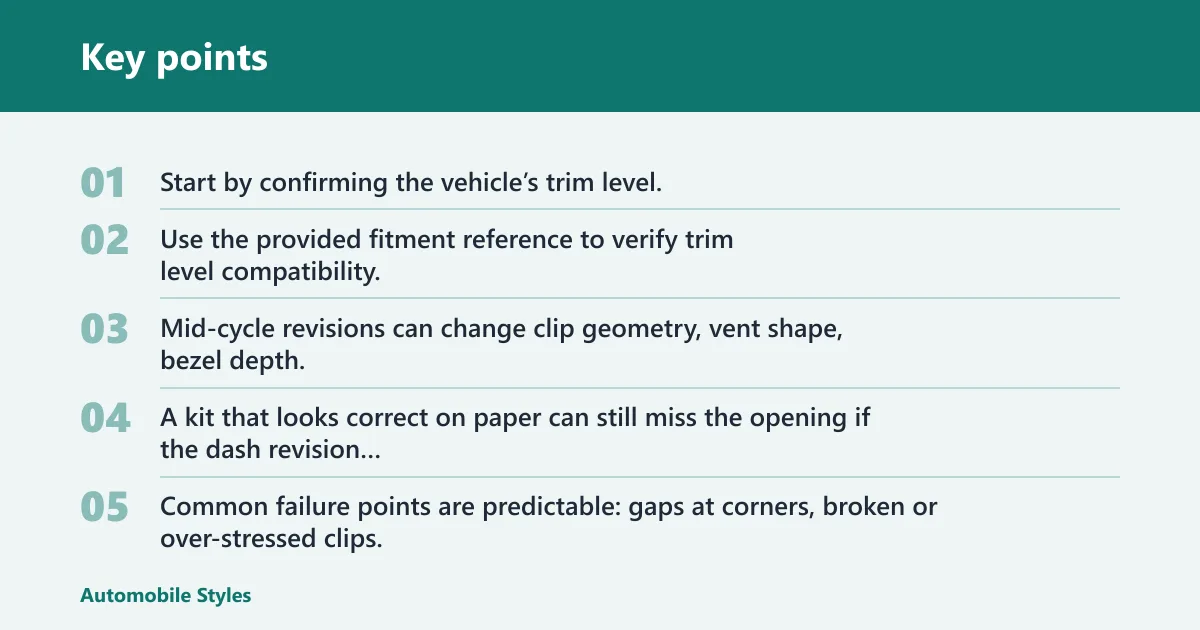
Start by confirming the vehicle’s trim level, then check production date and dash revision so you do not assume one model year fits every build. Use the provided fitment reference to verify trim level compatibility, and compare the factory listing to check OEM part-number interchange before you buy.
Model year alone is not enough. Mid-cycle revisions can change clip geometry, vent shape, bezel depth, or harness routing even when the brochure year stays the same. A kit that looks correct on paper can still miss the opening if the dash revision changed during the build run.
Common failure points are predictable: gaps at corners, broken or over-stressed clips, vent misalignment, switch interference, sensor interference, squeaks, and a grain or gloss level that does not match the surrounding dash. Those are fitment issues first and cosmetic issues second.
Cost
Dash trim kits usually cost less because they are designed to bridge the opening without replacing every factory-facing component. OEM trim often costs more, and the labor can rise if the assembly includes vents, lighting, HVAC controls, or infotainment pieces that must be transferred carefully.
Dealer ordering, part numbers, and availability also affect the total. OEM parts for a specific VIN-derived build configuration may require a special order, and a model-year match does not guarantee the same clip pattern or connector layout.
Durability
Most dash trim kits rely on ABS plastic, which is common and easy to shape, but it can lose appearance quality faster than factory trim when exposed to heat and sunlight over time. Cabin heat, windshield magnification, and repeated thermal cycling are the main stressors in parked vehicles.
Adhesive-backed kits depend on surface preparation, temperature, and contact area. Product guidance from adhesive manufacturers such as 3M consistently emphasizes clean surfaces and appropriate application conditions for reliable tape performance. If the surface is dusty, oily, or too textured, retention can drop and edges may lift.
Safety
Yes, fit matters for safety as well as appearance. A trim piece that sits too proud can interfere with airbag deployment zones, block vent vanes, pinch climate-control buttons, or make infotainment connectors harder to reach. The concern is clearance and service access, not the trim “talking” to the vehicle electrically.
That risk is highest when the trim surrounds embedded switches, sensors, or HVAC controls. If the bezel changes the clearance around those parts, a small alignment error can become a functional problem. In vehicles with integrated switch banks or sensor mounts, the wrong assembly can also complicate diagnostics and removal.
Resale
Replacing OEM trim usually has the edge because factory alignment and matched finish are easier for buyers to trust. A dash kit can still help resale if it is well-fitted, but any visible mismatch, gap, rattling edge, or interference with controls can work against the sale.
Does replacing OEM trim cost more?
Yes, in most cases. OEM trim usually costs more because you are paying for factory-fit geometry, matched surface finish, and parts that may come as a larger assembly instead of a simple overlay. Labor can also rise if the assembly includes vents, lighting, HVAC controls, or infotainment pieces that must be transferred.
Cost drivers
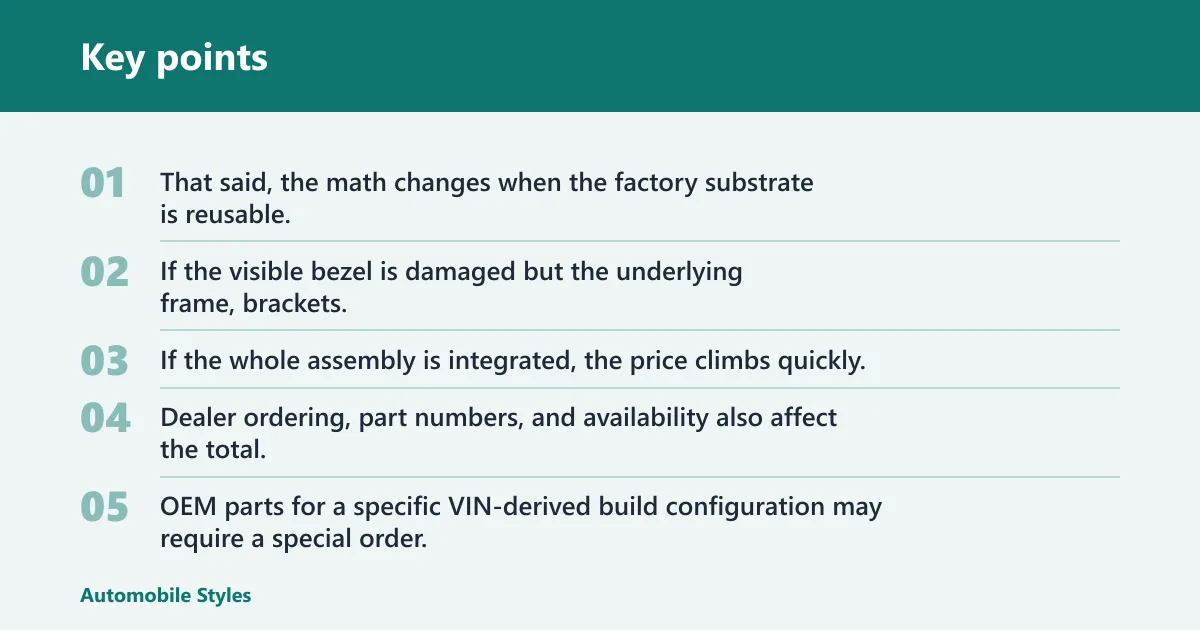
That said, the math changes when the factory substrate is reusable. If the visible bezel is damaged but the underlying frame, brackets, and clips are still good, OEM replacement may be less costly than expected because you are only replacing the outer piece. If the whole assembly is integrated, the price climbs quickly.
Dealer ordering, part numbers, and availability also affect the total. OEM parts for a specific VIN-derived build configuration may require a special order, and a model-year match does not guarantee the same clip pattern or connector layout.
Durability and materials
OEM trim generally has the advantage when you want the same material feel, surface texture, and long-term stability that the dashboard had from the factory. It is the safer route when you want the replacement to disappear into the original interior rather than stand out as an add-on.
Heat, UV, and material durability
Most dash trim kits rely on ABS plastic, which is common and easy to shape, but it can yellow, warp, or lose gloss under UV exposure and cabin heat. That matters in parked vehicles, especially where the windshield magnifies sun load and the dash sees repeated thermal cycling.
Higher-end kits sometimes use 3M VHB adhesive. That tape can work well, but its performance depends on temperature, surface preparation, and load direction. If the surface is dusty, oily, or textured beyond the tape’s limits, retention drops and the trim can shift or lift at the edges.
Durability checks should focus on UV exposure, thermal cycling, adhesion retention, and surface finish stability such as gloss retention. Those checks do not guarantee long life, but they are more useful than a glossy product photo when the car lives in hot sun.
Are aftermarket dash kits worth it for hot climates? They can be, but only if the material, adhesive, and installation method are suitable for heat. A well-made ABS kit with strong retention may hold up fine, while a weak adhesive bond can fail long before the part itself wears out.
Can a dash trim kit affect airbag, HVAC, or infotainment fitment?
Yes. This is a fit issue and a serviceability issue, not only a cosmetic one. A trim piece that sits too far proud can interfere with airbag deployment zones, block vent vanes, pinch climate-control buttons, or make infotainment connectors harder to reach. The risk rises when the dash has tight clearances.
Safety-related clearances
Safety-related concerns usually come from the trim’s physical position, not from electronics built into the trim itself. If the bezel changes the clearance around a switch bank, vent, sensor, or deployment zone, the wrong part can create functional interference and make future service harder.
Consider the warning signs before you buy. If the kit description does not address vent cutouts, connector access, or deployment zones, treat that as a gap in the fitment data. Functional systems should be checked first, style second.
Choose Dash trim kits if… / Choose replacing OEM trim if…
Choose Dash trim kits if you want a lower-cost update, need a reversible change, plan to keep the original trim, or are converting a dash opening for a single-DIN or double-DIN setup. They also make sense when the goal is a clean cosmetic refresh and the vehicle is not highly sensitive to factory-perfect alignment.
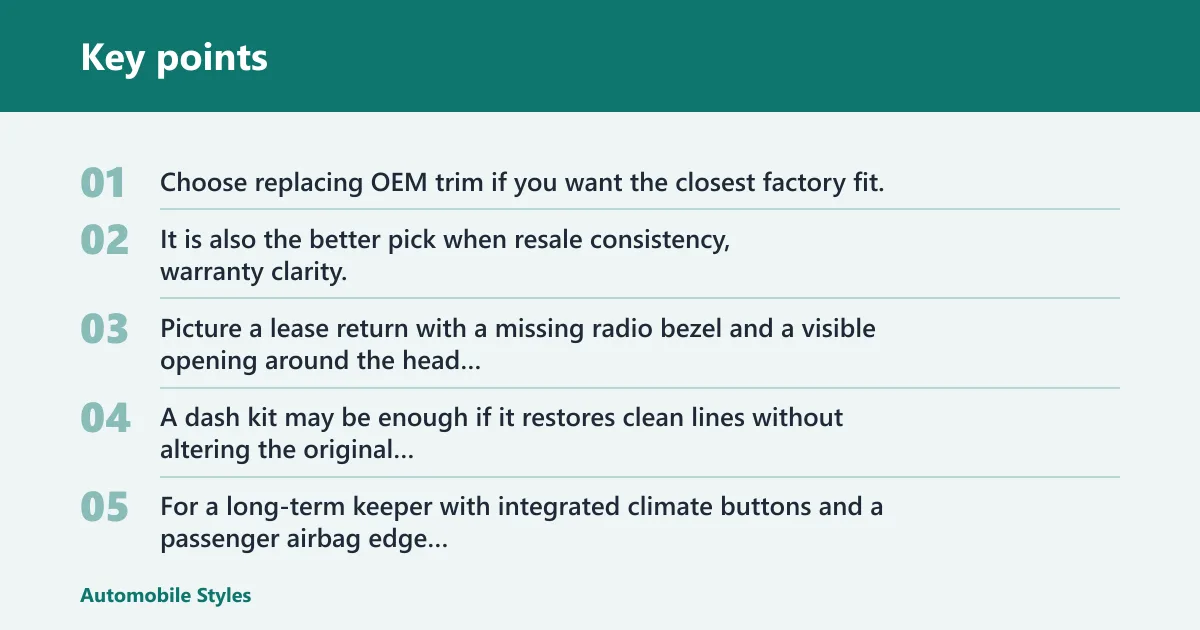
Choose replacing OEM trim if you want the closest factory fit, the best chance of matching the original finish, or the safest path around vents, switches, sensors, and airbag-related clearances. It is also the better pick when resale consistency, warranty clarity, or long-term serviceability matters more than saving money up front.
Picture a lease return with a missing radio bezel and a visible opening around the head unit. A dash kit may be enough if it restores clean lines without altering the original structure. For a long-term keeper with integrated climate buttons and a passenger airbag edge nearby, OEM trim is the safer and cleaner choice.
Daily driver
Dash trim kits usually win for a daily driver if the vehicle sees normal use and you want a practical, reversible upgrade. Keep the original parts, verify the build date, and check that vents and buttons still move freely after installation. If the car is stored outside, use heat-appropriate materials and adhesives.
Lease return
OEM trim usually wins for a lease return if the goal is to avoid questions about fit, finish, or missing factory parts. If a kit is used, it should restore the dash to a clean, close-to-stock state without leaving adhesive marks or altered mounting points.
Long-term keeper
OEM trim usually wins for a long-term keeper when the dashboard includes integrated controls, sensors, or a factory finish worth preserving. Dash trim kits can still make sense if the owner wants a reversible cosmetic update and accepts that climate, adhesive, and fit quality will matter over time.
Frequently asked questions
Is a dash trim kit better than replacing the OEM trim?
It is better when you want lower cost, easier reversal, and a cosmetic change that does not require full factory-level integration. Replacing OEM trim is better when exact fit, vent alignment, and factory-matched finish matter more than savings or flexibility.
Which option is better for resale value: dash kit or OEM trim?
Replacing OEM trim usually has the edge because factory alignment and matched finish are easier for buyers to trust. A dash kit can still help resale if it is well-fitted, but any visible mismatch, gap, or interference can work against the sale.
Are aftermarket dash kits worth it for hot climates?
They can be, but only if the kit uses durable ABS, stable finish, and a retention method suited to heat. In hot climates, UV exposure and repeated thermal cycling can loosen weak adhesives or distort low-grade plastic faster than many owners expect.
Do OEM trim parts require dealer ordering or a VIN?
Often yes. OEM trim is commonly tied to VIN-derived build configurations, and the exact model year may not be enough to confirm the right part. A production-date check helps avoid a mismatch in clips, vent shape, or connector routing.
What problems happen if a dash kit does not fit perfectly?
Common problems include gaps, broken tabs, rattles, squeaks, vent misalignment, switch interference, and cosmetic mismatch at the grain or gloss level. In more complex dashboards, a poor fit can also make removal harder later and can affect access to embedded electrical parts.
Dash trim kits vs replacing OEM trim checklist
Use this checklist before you order any dash trim kit or OEM replacement part:
- Confirm the exact trim level, model year, and production date.
- Verify whether the dash opening changed mid-year or by factory revision.
- Match the part number, clip layout, and connector count before purchase.
- Check vent cutouts, switch openings, and sensor clearances.
- Confirm whether the kit is designed for a specific radio, HVAC, or bezel style.
- Inspect the original trim for reusable brackets, clips, and hidden damage.
- Review adhesive requirements and surface-prep instructions if the kit uses tape.
- Choose OEM trim when fit, safety, or resale consistency matters most.