How to use an OEM part number interchange lookup
Use an OEM part number interchange lookup by starting with the exact source number, matching it to the VIN-based catalog application, and confirming the supersession or interchange only if the mounting, connector, dimensions, and revision code all match. A bad match can waste money and still leave you with a part that will not fit or function. This guide shows how to trace the number, read the format, check OEM catalog data, and compare the physical details before you order.
How OEM and interchange numbers differ
An OEM part number points back to the vehicle maker’s service reference for a part. An interchange number is broader: it groups OE and aftermarket numbers that fit the same applications, which means the right catalog path can lead to several equivalent numbers, not one. Use the VIN to narrow down the build before trusting either result.
The practical difference matters. The OEM number is the reference point, but the interchange result is application-based, not shape-based. That is why the same housing can fail a lookup, and why a number that formats correctly can still belong to the wrong family.
VIN-based catalog data is the authority when you need the exact OE number. Dealer parts counters and manufacturer online parts catalogs use the VIN to capture build-date splits, option codes, and mid-year changes that a plain number search can miss. Free tools may help, but they are best treated as a first pass.
How the workflow fits together
- Identify the vehicle by year, make, model, engine, transmission, and relevant options.
- Capture the part number from the part, label, invoice, or catalog record.
- Run the number through an OEM catalog or interchange database.
- Check for a supersession or replacement chain.
- Verify the physical specs that control fitment: connectors, mounting points, dimensions, output, and revision details.
Suppose the alternator on a tow-package truck has a number that looks right in a free lookup. That does not end the job. The heavier-duty unit can share the same family and still differ in output rating, connector layout, or bracket details.
How do you find the OEM part number?
Start with the vehicle and the part itself, then work outward. The cleanest source is the VIN in a dealer catalog or manufacturer parts catalog, because it identifies the exact build and can reveal option-dependent variants. If the part is already in hand, the label or tag often gives a better result than the housing casting.
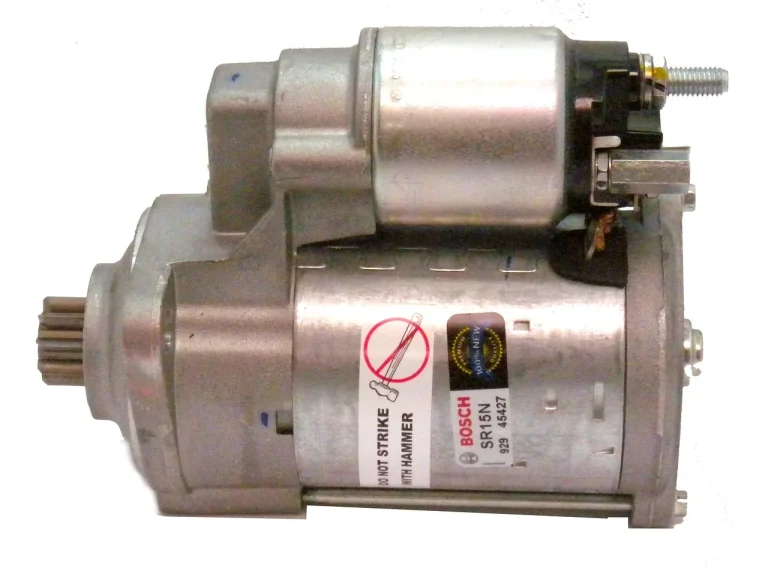
You can also find the number on an invoice, a repair order, or a parts counter printout. For many alternators and starters, the tag or label number is the preferred source because it often includes revision suffixes that a casting number does not show. A cast or stamped housing number may be present, but it is not the final service number by itself.
Where to look first
- Vehicle data: year, make, model, engine, transmission, and VIN.
- Part label or tag: especially useful on alternators and starters.
- Invoice or repair order: useful when the original service part was already cataloged.
- Catalog record: best for confirming the exact OE reference.
VIN-based lookup matters because build-date splits can create two parts for one model year. A car built before the split may use one connector or bracket style, while the later build uses another. The year alone will not tell you that.
What to decode from the number
Some number formats can hint at the issuing manufacturer family, but format matching only narrows the source. It does not confirm fitment or authenticity. For example, VINsearch gives Volkswagen Group as 1K0 615 301 AB and ties 615 to the brake group. It also shows Toyota examples such as 04465-30400 in a five-five format. Those patterns help you aim the search, not finish it.
How do you read supersessions and replacements?
A supersession means the old OEM number was replaced by a new one in the catalog. The old number may still appear on packaging, old invoices, or legacy listings, but the current service number points to the replacement chain. Read that chain before you order anything older than the latest catalog entry.
Catalog notices usually show the old part number, the new part number, and sometimes a note about applicability. If the earlier number was replaced because the manufacturer changed the connector, seal, or output specification, the old number is no longer the safe order choice. If the replacement is only a catalog update, the old and new numbers may still resolve to the same service part.
When the older number still works
Older numbers can remain valid when the catalog says they are superseded to the same current part. In that case, the old number is useful for tracing history, but the new number is what you should order. If the catalog shows a split by VIN, build date, or option code, use the line that matches the vehicle data, not the oldest number you can find.
What does an interchange part number mean?
An interchange part number groups OE and aftermarket numbers that fit the same applications. It is an application fit tool, not a promise that every visual match is correct. ACES and PIES support those listings: ACES describes fitment, while PIES describes product data such as dimensions, attributes, interchange, and images.
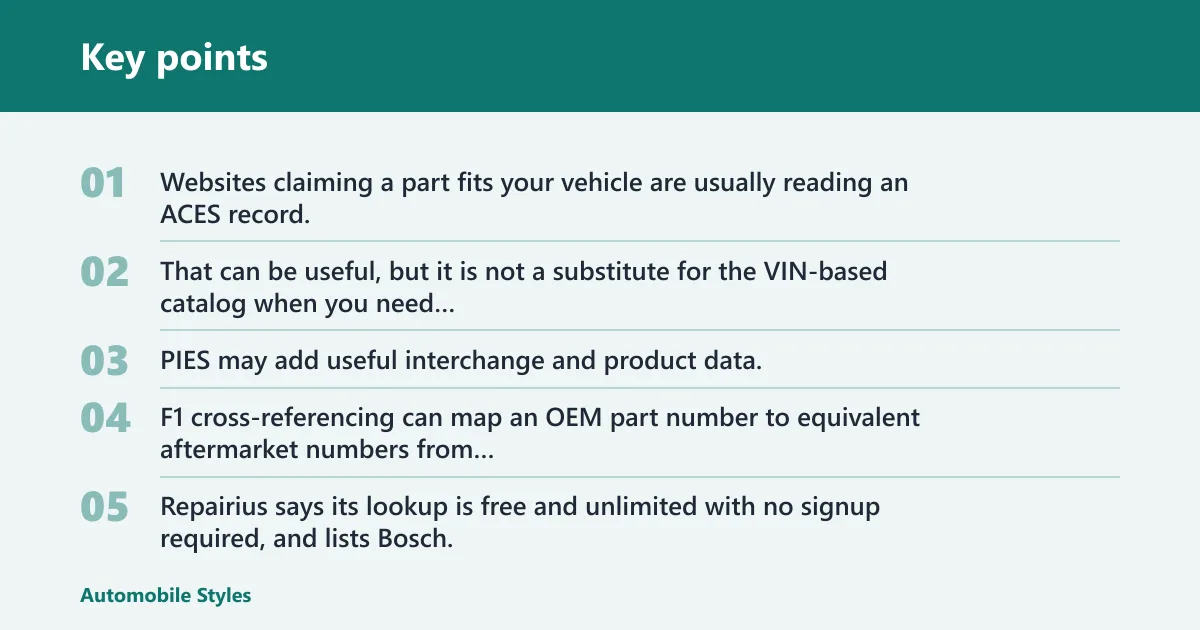
Websites claiming a part fits your vehicle are usually reading an ACES record. That can be useful, but it is not a substitute for the VIN-based catalog when you need the exact OE number. PIES may add useful interchange and product data, yet the listing still needs a physical check before you buy.
F1 cross-referencing can map an OEM part number to equivalent aftermarket numbers from major brands. Repairius says its lookup is free and unlimited with no signup required, and lists Bosch, Denso, ACDelco, NAPA, Wix, Fram, Gates, and Moog in its cross-reference scope. Useful? Yes. Final authority? No.
Why one OEM number can fit multiple vehicles
One OEM number can cover multiple vehicles when the same core part was used across trims, engines, or model lines. The reverse is also common: one model year can have two valid parts because of build-date splits, driveline changes, or an option package. That is why vehicle data matters as much as the number.
A common first-timer mistake is assuming one part shape means one part number. A brake caliper can look very similar from the outside and still differ in bleeder position, hose port angle, or bracket ear spacing. The catalog may group them separately even when the housings appear close.
Part lookup verification matrix
This table is the check point after a lookup, not before it. Use it when a source number returns multiple candidates, when a free tool gives a match without a VIN, or when a catalog result looks close but not exact. The goal is to compare the part family, the numbers on the part, and the physical traits that control fitment.
| Part family | OEM number | Casting number | Tag or label number | Required matching attributes | Common mismatch clues | What to do next |
|---|---|---|---|---|---|---|
| Alternators and starters | Service part number from catalog | Housing or case mark; may differ from service number | Preferred source on many units; often includes revision suffixes | Connector style, clock position, pulley type, output rating, mounting ear layout | Same case shape but wrong plug, wrong pulley, different amperage, missing suffix | Verify against VIN catalog and compare tag data before ordering |
| Brake calipers | OE service number tied to axle side and trim | Cast body number may not match service listing | Sticker or tag may show reman or core data | Left/right side, bleeder location, hose port thread, piston count, bracket spacing | Mirror-image housing, hose port on wrong side, pad ears do not line up | Match side, port layout, and bracket points to the catalog record |
| Axles | OE axle or shaft number from VIN catalog | Tube or shaft casting code, if present | Sometimes a paper or metal label on rebuilt units | Spline count, overall length, ABS tone ring style, flange pattern, differential type | Correct length but wrong spline count, wrong ABS tone ring, flange pattern mismatch | Check driveline, ABS, and axle code before purchase |
| Filters | OE filter number or cross-reference number | Usually not the controlling identifier | Box label or cartridge label may carry the usable reference | Thread size, gasket diameter, height, bypass valve spec, seal type | Container looks right but threads or gasket size differ, media depth not matched | Confirm dimensions and sealing specs, not the can shape alone |
Decision tree when the lookup returns more than one candidate
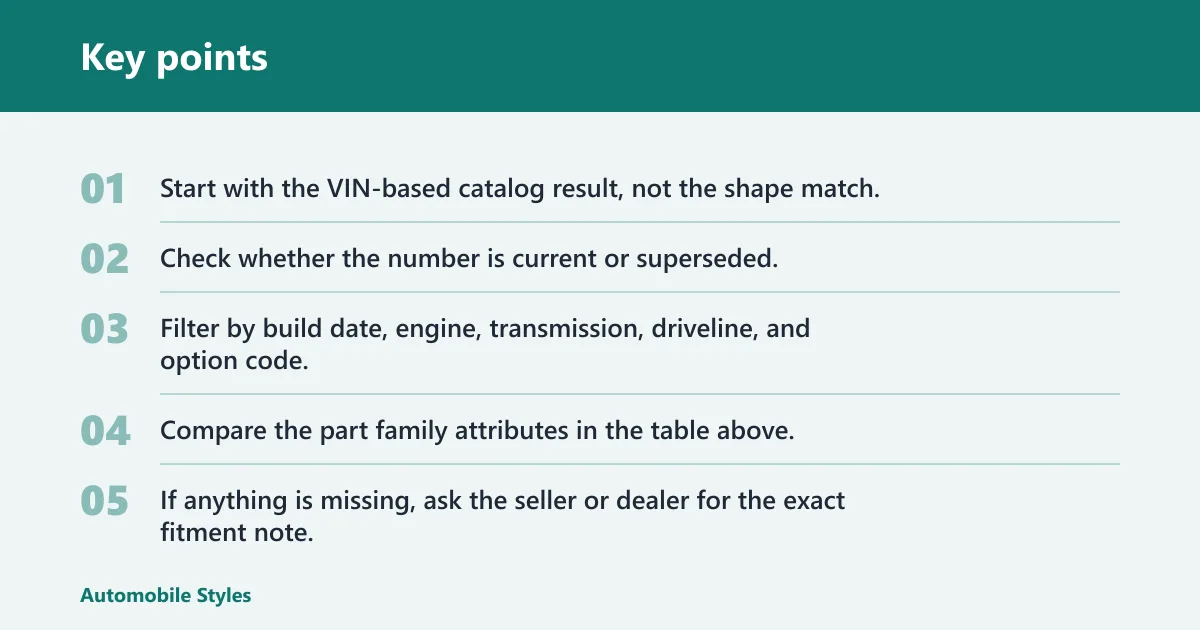
- Start with the VIN-based catalog result, not the shape match.
- Check whether the number is current or superseded.
- Filter by build date, engine, transmission, driveline, and option code.
- Compare the part family attributes in the table above.
- If anything is missing, ask the seller or dealer for the exact fitment note.
What if the number matches but the part still does not fit?
If the number matches but the part does not fit, the failure usually sits in a physical detail that the number did not capture. Connector style, clock position, mounting pattern, output rating, tooth count, and port layout are common causes. Left-right confusion and build-date splits can create the same problem even when the catalog number looks right.
Say your starter has the correct OEM number but the solenoid connector is clocked differently. The unit may bolt up and still not connect. Another common case is a caliper that matches the number but uses the wrong bleeder position, so the hose routing and bleed process are wrong from the start.
For axles, a number can match while the spline count or ABS tone ring does not. For filters, thread pitch and gasket diameter matter more than the canister’s outside shape. That is why the final check belongs to the mounting surfaces, ports, and service specs, not the photo alone.
Common failure modes to watch
- Wrong manufacturer family from format-only matching.
- Incomplete free lookup data that omits options or build-date splits.
- Casting number used alone as the identifier.
- Tag or label number ignored on alternators and starters.
- Interchange result accepted without VIN confirmation.
Can you trust a free OEM part number lookup?
A free lookup can be a good starting point, but treat it as best effort unless it ties back to a VIN-based catalog or a confirmed dealer number. Some tools can map a source number to equivalent aftermarket numbers, and that is useful. Still, format-only tools can point to the wrong family or miss a supersession.
The same source says its lookup is free and unlimited with no signup required, which makes it easy to use for a quick cross-reference. That convenience does not replace dealer parts counters or manufacturer online parts catalogs with VIN, which USAind identifies as the authoritative source for the OE number.
What to confirm with the seller or dealer
- Current OEM number and any supersession chain.
- VIN match for year, make, model, engine, transmission, and options.
- Build date split, if the model year has one.
- Side, connector, port, tooth, or bracket details.
- Whether the listing is for OEM, interchange, or aftermarket replacement.
If the seller cannot explain why the number superseded or which build it fits, pause. The safest order is the one backed by VIN data and the exact physical attributes that apply to the part family.
Frequently asked questions
How do I find the OEM part number for my car?
Use the VIN first, then confirm year, make, model, engine, transmission, and relevant options in a dealer or manufacturer catalog. If the part is already out of the car, the tag or label can help, especially on alternators and starters. Do not rely on the casting number alone.
How do I use an OEM part number interchange lookup?
Start with the exact source number, identify whether it is current or superseded, then compare the VIN-based catalog result to the interchange listing. If the lookup returns several candidates, filter by build date, options, and part-family specs such as connector type, port location, output, or thread size.
Why does one OEM number fit multiple vehicles?
Manufacturers often use the same service part across several vehicles that share the same platform, engine family, or accessory package. The same number can also appear after a supersession. That is normal, and it is why the catalog application matters more than the number by itself.
What if the part number matches but the part still does not fit?
Check the details that control installation and function: mounting points, connector layout, clock position, output rating, tooth count, port arrangement, and side. A number can be valid and still be wrong because of a build-date split, a heavy-duty option, or a left-right difference.