Dyed vs carbon vs ceramic window tint: Which should you buy?
Dyed tint costs the least up front, carbon gives the best balance for most drivers, and ceramic delivers the strongest heat rejection plus the longest comfort payoff over years of use. Pick the wrong film and you may save money now, then deal with hotter cabin temps, faster fading, or an install that needs replacing sooner. This guide compares cost, heat control, durability, and ownership horizon so you can choose the right film for your car.
| Decision factor | Dyed | Carbon | Ceramic | Winner |
|---|---|---|---|---|
| Upfront cost | Lowest; about $100–$250 per vehicle | Mid-range; about $250–$450 per vehicle | Highest; about $400–$900 per vehicle | Dyed |
| Heat control | Moderate-to-low | Better than dyed | Highest; premium nano-ceramic can reach up to 65%+ TSER | Ceramic |
| Durability and fade resistance | Low; often 3–5 years, with purple fading risk | High; around 5–10 years | Excellent; often 10+ years | Ceramic |
| Signal friendliness | None for signal interference | None for signal interference | None for signal interference | All three |
| Best lifetime value | Only if you want short-term appearance | Strong middle ground for most owners | Best comfort-per-year for hot climates and long ownership | Carbon or ceramic, depending on climate and horizon |
Dyed vs carbon vs ceramic: the real trade-off
The real choice is not darkness alone. It comes down to price, how long you will keep the car, and whether heat control matters more than a lower sticker price. Dyed film buys privacy cheaply, carbon gives you a more balanced ownership experience, and ceramic gives the strongest comfort per year.
Price versus comfort per year
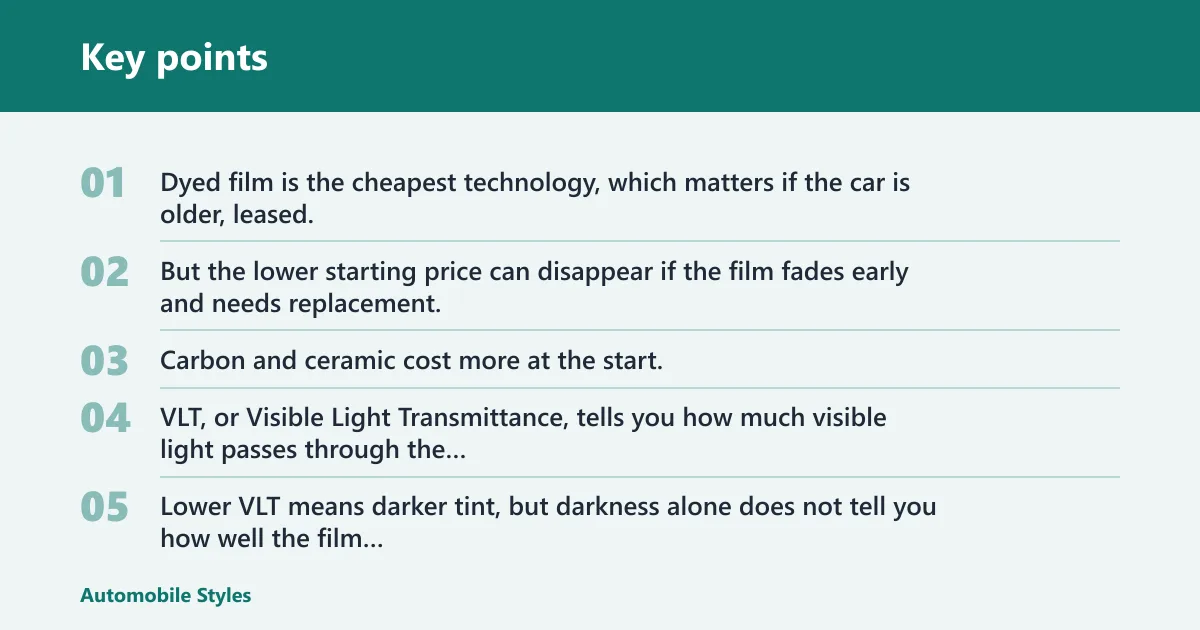
Dyed film is the cheapest technology, which matters if the car is older, leased, or likely to be sold soon. But the lower starting price can disappear if the film fades early and needs replacement. Carbon and ceramic cost more at the start, yet they stretch the useful life of the install.
Why darkness is not cooling
VLT, or Visible Light Transmittance, tells you how much visible light passes through the glass. Lower VLT means darker tint, but darkness alone does not tell you how well the film rejects heat. A darker dyed film can still perform worse than a lighter ceramic film on hot days.
That is where TSER and IRR matter. TSER measures total solar energy rejected, while IRR focuses on infrared heat rejection. Premium nano-ceramic films can hit 90%+ IRR at any VLT, and modern nano-ceramic films at 70% VLT can match the heat rejection of older 20% VLT dyed films.
Where ownership length changes the answer
If you plan to keep a car for two or three years, dyed can make sense because you may not own it long enough to care about fading. If you plan to keep the car through multiple summers, the extra spend on carbon or ceramic usually makes more sense because replacement changes the math.
Say your sedan needs rear-door and back-glass tint, and you drive it for a 40-minute commute in a hot climate. A dyed film may look good on day one, but if it starts fading in year four, you are paying twice for the same windows. That is the hidden cost buyers often miss.
Window tint decision matrix
This matrix turns the choice into a lifetime-value decision. The “hidden cost” column matters because a cheaper film that needs replacing sooner can end up costing more than a better film that lasts longer.
| Film type | Typical upfront price tier | Expected lifespan | Best-fit driver profile | Likely hidden cost over 5-10 years from fading/replacement | Hot climates | Commuter cars | Budget builds |
|---|---|---|---|---|---|---|---|
| Dyed | Lowest; about $100–$250 per vehicle | 3–7 years; often 3–5 years before fade becomes noticeable | Appearance-first owners, short holds, privacy on a tight budget | Higher if you keep the car long enough to replace faded film | Skip unless budget is the top priority | Only if you plan a short ownership period | Best fit |
| Carbon | Mid-range; about $250–$450 per vehicle | 5–10 years | Most daily drivers who want better comfort without paying premium prices | Moderate; fewer replacements than dyed, less risk of early fade | Good choice | Strong choice | Good if the budget can stretch |
| Ceramic | Highest; about $400–$900 per vehicle | 8–10+ years | Hot-climate drivers, long-term owners, anyone who values cabin comfort | Lowest over long ownership because replacement risk is smallest | Best fit | Best fit if the car stays in service for years | Usually too expensive unless heat matters a lot |
Best fit for hot climates, commuter cars, and budget builds
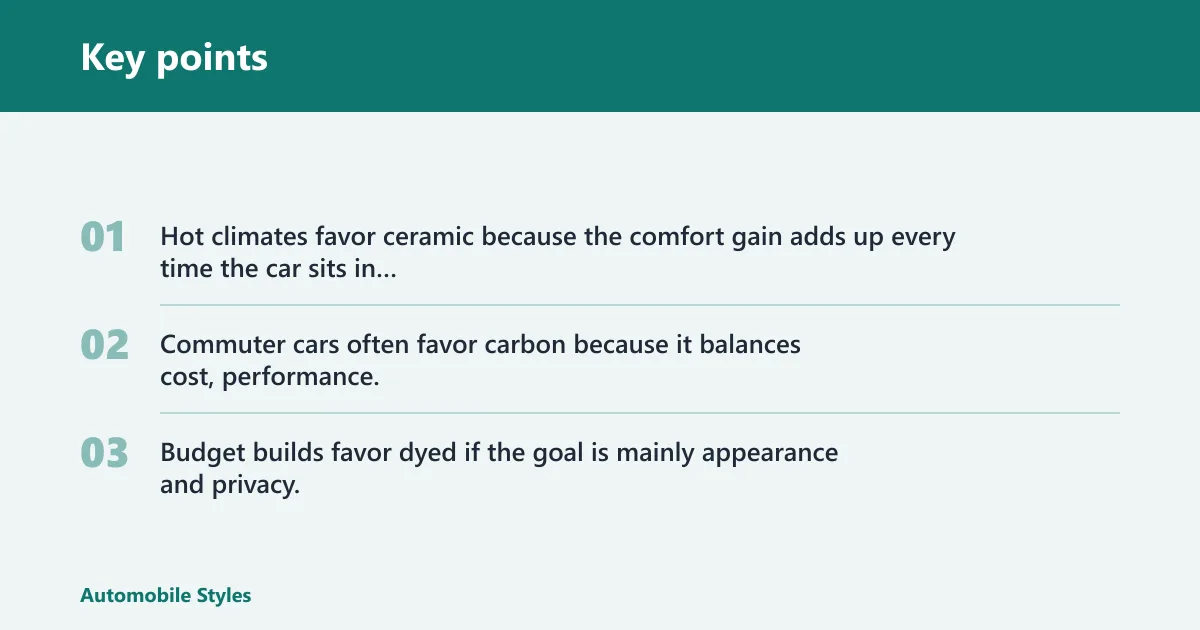
Hot climates favor ceramic because the comfort gain adds up every time the car sits in the sun. Commuter cars often favor carbon because it balances cost, performance, and life expectancy. Budget builds favor dyed if the goal is mainly appearance and privacy, not the strongest heat rejection.
What is dyed window tint?
Dyed window tint is the entry-level film. It uses a dye layer to darken glass, gives the car a cleaner look, and sits at the lowest price tier. It also has moderate-to-low heat rejection, so its appeal is mostly privacy and appearance rather than serious cabin cooling.
Heat rejection, privacy, and purple fading
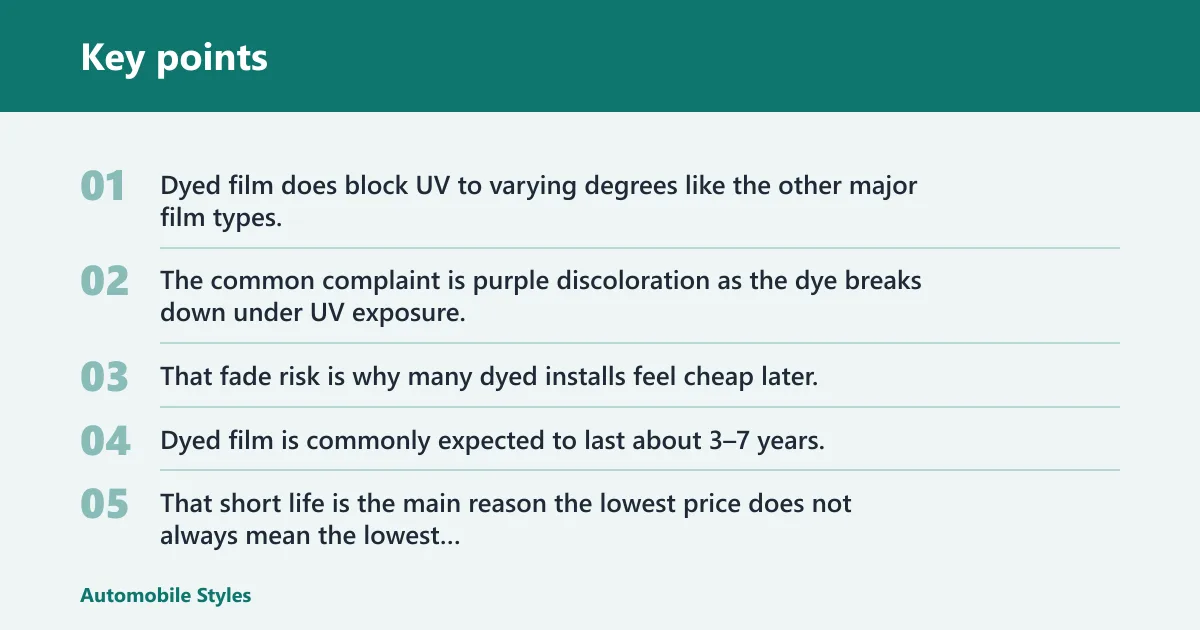
Dyed film does block UV to varying degrees like the other major film types, but it is known for fading over time. The common complaint is purple discoloration as the dye breaks down under UV exposure. That fade risk is why many dyed installs feel cheap later, even if they looked good at first.
Dyed film is commonly expected to last about 3–7 years, though some sources describe it as closer to 3–5 years with lower fade resistance. That short life is the main reason the lowest price does not always mean the lowest total cost.
Why some buyers still choose it
Dyed film still makes sense if you want a basic privacy upgrade and do not plan to keep the car very long. It is also a practical choice for older vehicles where a premium install would not match the car’s remaining value. The problem starts when buyers expect dyed film to cool like ceramic.
What is carbon window tint?
Carbon window tint is the mid-tier option. It uses carbon particles instead of dye, which improves fade resistance and heat rejection while avoiding the signal issues associated with metallic films. It usually lands in the middle for both price and performance.
Why carbon differs from dyed film
Carbon film is a solid mid-tier choice that does not block signals. It also has a matte finish that many buyers prefer because it avoids the look of a glossy, heavily tinted pane. Compared with dyed film, it is less likely to turn purple and more likely to hold its appearance.
Typical pricing is often around $250–$450 per vehicle, with an expected lifespan of about 5–10 years and generally strong fade resistance. That puts carbon in a useful middle lane for drivers who want more than cosmetic tint, but do not need the premium price of ceramic.
Why many buyers land here
Carbon often wins because it fixes the main weakness of dyed film without forcing the jump to premium pricing. For a daily driver in a moderate climate, the step up from dyed to carbon is often easier to justify than the step from carbon to ceramic. It is the practical pick for many commuter cars.
Suppose a crossover sits in an office lot five days a week and carries kids to school on weekends. Carbon can be the sensible middle choice: better heat control than dyed, a cleaner finish, and fewer concerns about replacing faded film a few years down the road.
What is ceramic window tint?
Ceramic window tint is the premium film type. It uses nano-ceramic particles, gives the highest heat rejection, and usually lasts the longest. It is also the most expensive choice, so it is the one to buy when comfort and long-term ownership matter more than first cost.
Nano-ceramic particles and heat rejection
Premium nano-ceramic films can reach up to 65%+ TSER, which is the strongest heat rejection cited here. They can also hit 90%+ IRR at any VLT, which is why a lighter ceramic film can still outperform a darker dyed film on cabin comfort.
That last point matters because buyers often equate darker with cooler. A 70% VLT ceramic film can match the heat rejection of an older 20% VLT dyed film, so the shade number alone does not tell the full story.
IRR, TSER, and UV protection
IRR helps explain how well the film blocks infrared heat, while TSER shows the overall solar load it rejects. Ceramic films tend to lead both numbers, and they also offer strong UV protection. That combination is what makes them feel stronger in real hot-weather use, even when the tint is not very dark.
Why lighter ceramic can feel cooler
Because heat rejection and visible darkness are different measures, a lighter ceramic can cool the cabin better than a darker dyed film. That matters for legal compliance too. You can stay at a legal VLT, keep decent outward visibility, and still gain meaningful heat reduction if the film uses modern ceramic technology.
Does carbon or ceramic interfere with signals?
No, not in normal use. Dyed, carbon, and ceramic films are generally signal-friendly, and the comparison data here lists none for signal interference across all three. The main interference problem usually comes from metallic films, not these three common non-metallic types.
Phone, GPS, cellular, and keyless-entry compatibility
That matters for daily driving because many owners want to protect phone reception, GPS performance, cellular service, and keyless-entry range. Carbon and ceramic are both non-metallic, so they are the safer answer when you want modern electronics to keep working as expected.
What buyers should ask installers
Ask for the exact film line, not just the broad category. Some premium products still vary in VLT, TSER, and warranty length. You should also ask whether the quoted film is non-metallic and whether the installer can document the legal VLT needed for your state.
Choose dyed if… choose carbon if… choose ceramic if…
Choose dyed if your main goal is low-cost privacy, you want the cheapest install, or you plan to sell the car before fading becomes a real issue. Choose carbon if you want a balanced daily-driver film with better heat rejection and a stronger lifespan than dyed. Choose ceramic if you live in a hot climate, keep cars for years, or want the strongest comfort per year of ownership.
Choose dyed if…
- You want the lowest upfront price and basic privacy.
- You are tinting an older car where long-term durability matters less.
- You expect to replace the car or the film within a short ownership window.
Choose carbon if…
- You want better heat control than dyed without paying premium money.
- You care about a matte look and long signal compatibility.
- You plan to keep the car long enough for durability to matter, but not long enough to justify ceramic.
Choose ceramic if…
- You drive in hot weather and want the strongest cabin comfort.
- You keep vehicles for many years and want to avoid early replacement.
- You are willing to pay more now for the best long-term value in heat rejection and durability.
Frequently asked questions
Which is better: dyed, carbon, or ceramic window tint?
For most drivers, carbon gives the best balance of cost, heat rejection, and lifespan. Dyed is the budget choice when appearance matters more than long-term performance. Ceramic is the premium answer when you want the strongest heat control and the longest ownership payoff, especially in hot climates.
Is carbon tint worth the extra money over dyed tint?
Yes, for many owners. Carbon usually costs more up front, but it offers better heat rejection, higher fade resistance, and a longer useful life. If you keep the vehicle for more than a few years, the extra cost often makes sense because it reduces the odds of replacement.
Does ceramic tint really keep a car cooler than dark dyed tint?
Usually, yes. Ceramic films can post much higher TSER and IRR numbers than dyed films, and modern nano-ceramic film can outperform an older, darker dyed film even at a lighter VLT. That is why darkness alone is a weak way to judge cooling.
Will carbon or ceramic tint interfere with phone, GPS, or radio signals?
Normally, no. Carbon and ceramic are both non-metallic and are generally signal-friendly. Dyed film is also not the kind of film that usually causes signal trouble. The real problem is metallic tint, so ask installers whether a film contains metal before you buy.
How long does dyed tint last before it fades purple?
Common listings put dyed film at 3–5 years before purple fading becomes a real concern, and broader lifespan estimates often run around 3–7 years. Sun exposure, parking habits, and film quality all affect that timeline, but dyed is still the shortest-lived of the three.
What is the price difference between dyed, carbon, and ceramic tint?
Dyed is typically about $100–$250 per vehicle, carbon about $250–$450, and ceramic about $400–$900. Those ranges make the lifetime decision clear: dyed is cheapest now, carbon is the middle ground, and ceramic costs the most but can return more comfort over time.