OEM vs genuine vs aftermarket: What’s the difference?
OEM means the part matches the automaker’s spec; genuine means it came in the carmaker’s branded box; aftermarket means a non-OE brand made a compatible replacement, and fit should be proven by exact part number, interchange data, or measured spec. Pick the wrong label and you can buy a wrong-fit part, stall a repair, or spend more on return shipping. This guide shows how to decode a listing quickly and check what the box, seller, and part number likely mean.
| Decision factor | OEM | genuine | aftermarket | Winner |
|---|---|---|---|---|
| Packaging and branding | Often supplier-branded, not automaker boxed | Automaker box, logo, and part number | Independent brand, varies by seller | genuine for proof of origin |
| Fit confidence | High when the exact supplier part number matches | High when the dealer number matches the VIN | Ranges from exact fit to broad compatibility claims | genuine or OEM, tied to part number |
| Price | Often cheaper than genuine | Usually highest price tier | Wide spread, from economy to premium | aftermarket for lowest upfront cost |
| Risk of misleading listing | Moderate if seller uses “OEM” loosely | Lower, but counterfeits still exist | Higher, because quality claims vary more | genuine, if provenance is verified |
OEM vs genuine vs aftermarket: the trade-off
The trade-off is simple: genuine gives the cleanest paper trail, OEM gives the closest match to original factory supply, and aftermarket gives the widest price spread. The right choice depends on how much proof you need, how sensitive the part is, and how expensive a fit mistake would be.
Brand label versus maker identity
Genuine parts are dealer parts in the vehicle maker’s packaging, with the automaker logo and part number on the box and often on the part itself. OEM parts are made by the original equipment manufacturer or supplier, and they may be sold under that supplier’s own branding. Aftermarket parts come from independent manufacturers and can range from basic replacements to premium upgrades.
Fit confidence versus price
Genuine parts usually sit at the top of the price ladder because dealer channels and automaker branding carry a premium. OEM and OE parts often cost less when the same supplier sells the same core part outside the dealer channel. Aftermarket parts can cost less again, but you need to check exact fit, revision, and build quality before you buy.
What you can verify in 60 seconds
Start with the part number, not the marketing copy. A seller listing that shows the vehicle manufacturer part number, the supplier’s name, a clear box photo, and the actual part marking usually gives stronger evidence than “fits like original” text alone.
Say your brake pad listing says “OEM quality” and “factory fit” but shows no box photo, no supplier number, and no caliper application chart. That is not proof. A real fit check needs a catalog number, vehicle coverage by VIN or model year, and visible markings that match the claim.
Side-by-side part labels
These labels are often used loosely in listings. The box matters, but it is not the whole story. The part number, supplier mark, and source documents tell you more than a logo alone.
| Label | What it usually means | What it does not prove |
|---|---|---|
| Genuine parts | Dealer boxed, automaker logo, automaker part number | That the internal manufacturer is unique to the automaker |
| OEM parts | Made by the factory supplier, often sold under supplier branding | That it arrives in automaker packaging |
| OE parts | Original equipment fitted on the assembly line, sometimes the exact factory supplier part | That every OE-labeled listing is still factory boxed |
| OES parts | Built to original equipment standards, but not necessarily the exact factory-supplied part | That it is the same item originally installed on your vehicle |
| Aftermarket parts | Independent replacement parts, from economy to premium | That the quality or fit is automatically equivalent |
Who made it
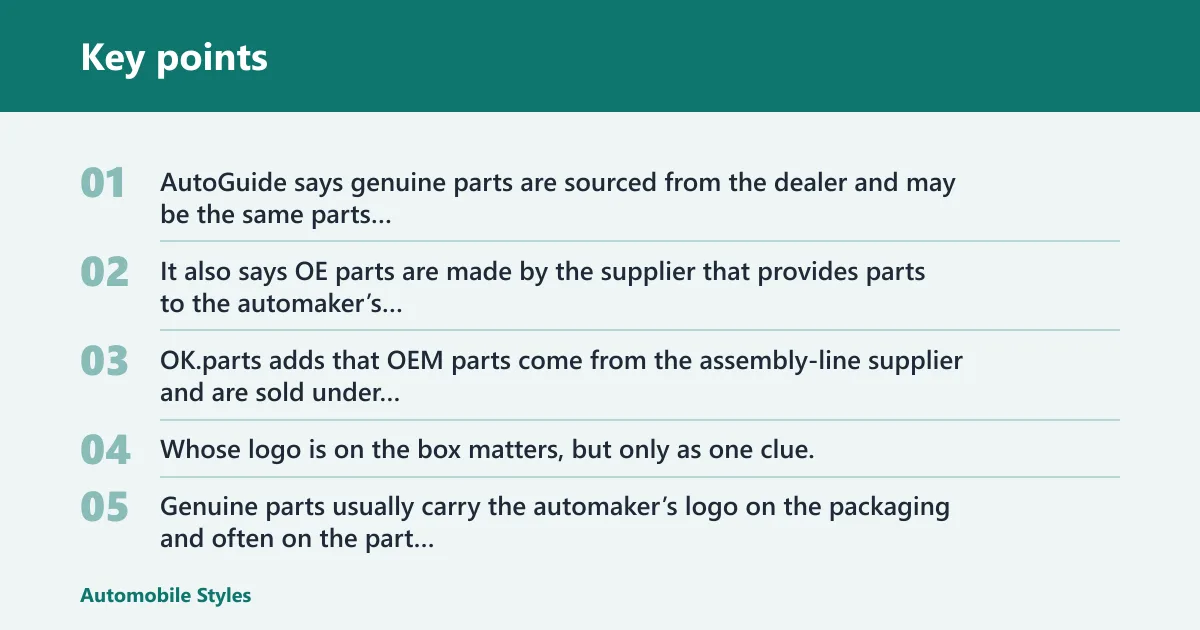
AutoGuide says genuine parts are sourced from the dealer and may be the same parts installed on the assembly line. It also says OE parts are made by the supplier that provides parts to the automaker’s factory. OK.parts adds that OEM parts come from the assembly-line supplier and are sold under that supplier’s own brand.
Whose logo is on the box
Whose logo is on the box matters, but only as one clue. Genuine parts usually carry the automaker’s logo on the packaging and often on the part itself. That can help separate dealer boxed parts from supplier boxed parts, but it still does not prove the seller shipped the right revision.
How the part may be sold
Some North American automakers use aftermarket to mean any parts not made by the automaker or its Tier 1 suppliers. That is one reason listings can be confusing. The same supplier may sell the factory version through one channel and a replacement-market version through another, with different branding and part numbers.
What the label does not prove
A label never proves the part will fit your exact vehicle. It also does not rule out a counterfeit, a superseded revision, or a seller that copied the wrong catalog text. The proof comes from matching the automaker part number, checking the supplier stamp, and comparing the seller’s photos with the actual item.
How can the same supplier be OE and aftermarket?
The same supplier can be OE for one vehicle and aftermarket for another because factory supply and replacement sales are often separate channels. A supplier may make a part for the assembly line and also sell a separate boxed version for the repair market.
Factory supply versus replacement market
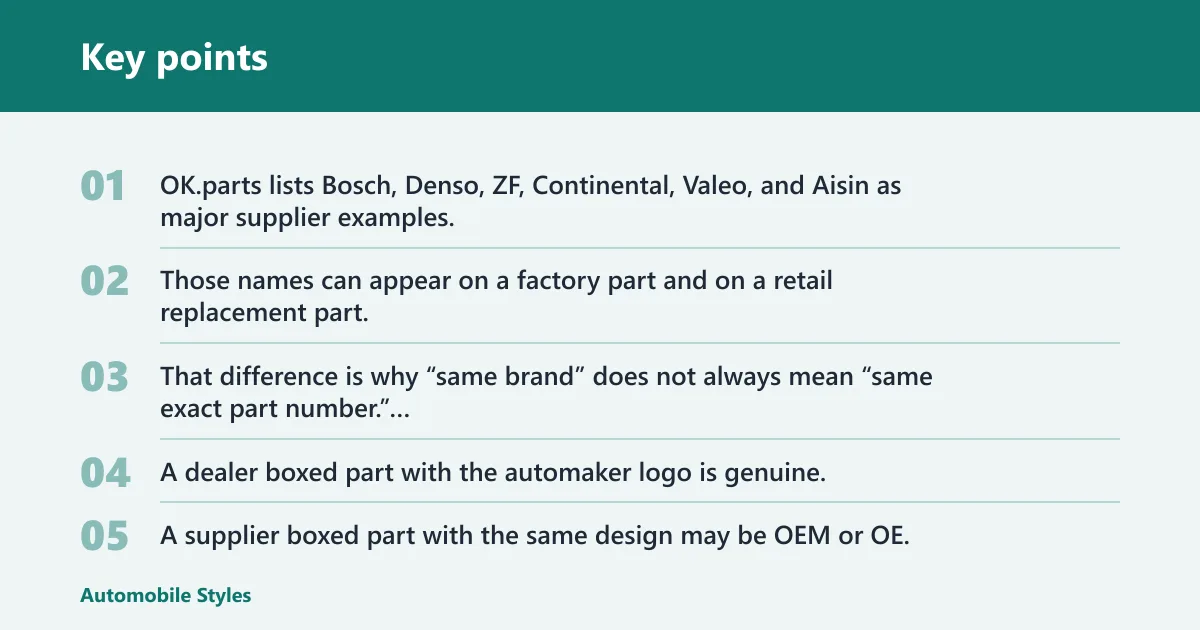
OK.parts lists Bosch, Denso, ZF, Continental, Valeo, and Aisin as major supplier examples. Those names can appear on a factory part and on a retail replacement part, but the packaging and catalog wording may differ. That difference is why “same brand” does not always mean “same exact part number.”
Why packaging changes the label
Supplier branding can change the sales lane without changing the core fit. A dealer boxed part with the automaker logo is genuine. A supplier boxed part with the same design may be OEM or OE. A similar part sold only under the supplier’s retail line may be aftermarket, even if the supplier also builds factory parts.
Suppose a wheel bearing is sold as a dealer part, and the box shows the vehicle maker’s logo plus a revision suffix on the part number. A second listing shows the same supplier brand but a different suffix. Those suffix letters matter. They can mark a revision, a supersession, or a packaging change, and they should be checked against the catalog.
Why the part number matters more than the marketing copy
The part number is usually the main reference point. If the vehicle manufacturer number does not match, or if the suffix letters point to a later revision, the listing may still be wrong even when the title says OEM, OE, or direct replacement. The safest listings often show the exact number, the compatible VIN range, and a clear photo of the actual part stamp.
What to check before you buy
Check the number, the markings, and the seller’s proof. A listing is far more reliable when it shows the exact vehicle manufacturer part number, the supplier brand, and photos of the actual box and part, not only stock art. If the seller cannot provide those, treat the fit claim as unproven.
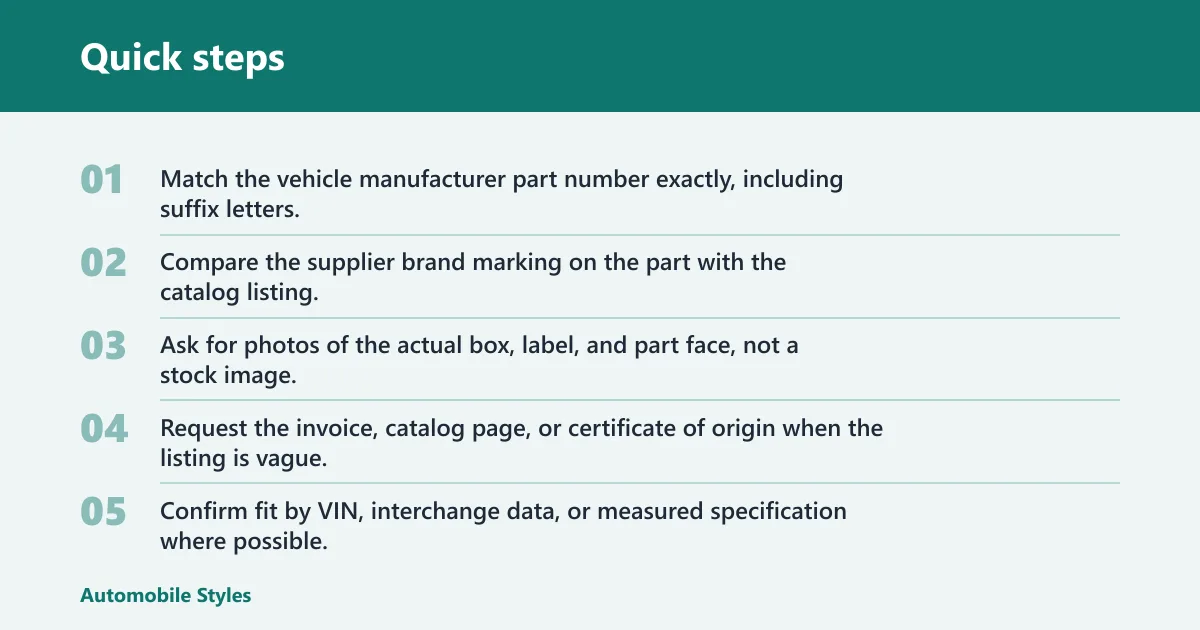
- Match the vehicle manufacturer part number exactly, including suffix letters.
- Compare the supplier brand marking on the part with the catalog listing.
- Ask for photos of the actual box, label, and part face, not a stock image.
- Request the invoice, catalog page, or certificate of origin when the listing is vague.
- Confirm fit by VIN, interchange data, or measured specification where possible.
Vehicle manufacturer part number and suffix letters
Suffix letters can indicate a revision, and that matters. A part with the same base number but a different ending may be an updated version, a superseded unit, or a different application. If the listing does not explain the suffix, ask for the latest catalog reference before buying.
Supplier brand markings
Supplier stamps are useful when they match the claim. A Bosch, Denso, ZF, Continental, Valeo, Aisin, Mahle, Brembo, or KYB mark can support an OEM or OE claim, but only if the number and application line up. A brand stamp by itself is not enough.
Seller photos of the actual box and part
Request photos of the box label, the part face, and any molded or etched number. Counterfeit parts often copy genuine packaging, so the box alone is not enough. A clear image of the actual part is more valuable than a polished marketplace description.
Invoice, catalog page, or certificate of origin
Documentation matters when the claim is specific. An invoice can show the seller’s stated part number. A catalog page can show interchange data. A certificate of origin can help establish provenance when the item is expensive or the market has known counterfeit risk.
Part listing truth test
This table helps you read common marketplace phrases fast. Treat each line as a prompt to ask for one more piece of proof, not as a guarantee.
| Listing wording | What it usually means | What evidence to request next |
|---|---|---|
| OEM equivalent | Claims similar fit or spec, not necessarily factory origin | Exact part number, interchange chart, and actual part photo |
| Genuine | Dealer boxed automaker part | Box label photo, automaker logo, and matching part number |
| OE supplier | Made by the supplier for the factory, or a supplier-brand part | Supplier name, factory number, and catalog cross-reference |
| Factory fit | Claims original fit, but wording may be loose | VIN match, revision suffix, and measured spec sheet |
| Direct replacement | Should replace the original part without modification | Exact OE number and vehicle application list |
| Dealer quality | Marketing claim, not a sourcing proof | Dealer invoice, brand origin, and part number |
| Original equipment | May mean OE, genuine, or just compatible | Source channel and exact manufacturer number |
| Factory spec | Claims to meet the original design target | Specification sheet and test standard used |
| Compatible | Fits the application, but origin may differ | Interchange data and side-by-side dimension check |
| Same as original | Often a loose fitment claim | Original part number plus molded or etched number |
| Meets OE standards | Built to standard, not always the same source part | Standard reference, supplier name, and batch code |
| Replacement part | General aftermarket item with no origin claim | Brand reputation, warranty terms, and exact application |
Which parts should you buy carefully?
Start with the part’s job. The more the part affects braking, steering, airbag deployment, fuel delivery, or charging, the more you should value exact number matches and stronger documentation. Trim pieces and cosmetic items can tolerate more brand variation, but they still need the right fit.
Safety-critical parts
Brake hydraulics, steering components, suspension joints, airbags, and ignition or fuel parts deserve the strictest proof. For these, a known OE or genuine part often reduces fit risk and avoids diagnosis headaches. A premium aftermarket part can still be sensible, but only when the number, standard, and application are clear.
Daily-driver parts
Filters, wiper blades, belts, sensors, batteries, and many mounts often have solid aftermarket choices. The same source notes that aftermarket quality and price vary widely, so the better question is not “aftermarket or not,” but “which brand, which revision, and which fit proof?”
Trim and cosmetic parts
Grilles, badges, clips, interior trim, and weather seals can be good aftermarket buys when the dimensions match and the part is easy to inspect on arrival. A low-cost option can be fine here, but a bad clip pattern or hole spacing still wastes time.
Performance parts
Aftermarket is often the right lane for performance upgrades. That category can include brake pads, dampers, intakes, exhaust parts, and cooling components tuned for a different result than stock. The trade-off is simple: better output may come with more noise, dust, stiffness, or maintenance.
Choose genuine if… / Choose aftermarket if…
Choose genuine when the part is hard to access, a wrong fit would cost a lot, or you need the dealer paper trail. Choose aftermarket when the part is non-critical, the brand has a clear catalog, or you want a lower-cost replacement with known fit data. OEM or OE is the middle ground when you want original-source confidence without dealer packaging.
Choose genuine if…
Choose genuine if the vehicle is under a warranty or insurance requirement that calls for a specific part type in your region or policy. Choose it if the part number must match a dealer record, or if a counterfeit-prone market makes provenance checks more important than saving money. Choose it if you want the cleanest packaging trail.
Choose aftermarket if…
Choose aftermarket if the part is a wear item, the brand has a proven catalog, and the seller can supply exact fit data. Choose it if you want a budget option for trim, filters, or common maintenance items. Choose premium aftermarket when you want a performance change, not just a replacement.
When OEM or OE is the best middle ground
OEM or OE makes sense when you want the factory supplier’s part without the dealer markup. That is especially useful for sensors, switches, hoses, and hardware where the original supplier brand is known and the part number is easy to verify. It is often the best compromise between proof and price.
Frequently asked questions
What’s the difference between OEM, genuine, and aftermarket parts?
OEM parts come from the original equipment manufacturer or supplier and often match the factory specification. Genuine parts are dealer boxed and carry the automaker logo and part number. Aftermarket parts are made by independent manufacturers, and quality, fit, and price vary widely.
Are OEM parts the same as genuine parts?
Not always. Genuine means the automaker sold the part in its branded packaging. OEM usually means the supplier made the part to the factory spec and may sell it under its own brand. The same physical design may exist in both forms, but the packaging and sales channel differ.
Is genuine better than OEM or aftermarket?
Genuine is not automatically better, but it often gives the clearest fit and provenance trail. OEM can deliver the same core part without dealer packaging. Aftermarket can be perfectly suitable, especially for wear items or upgrades, if the listing shows exact fit and the seller can prove origin.
How do I know if a part is actually OEM?
Check the supplier name, the exact manufacturer number, and the vehicle manufacturer cross-reference. Ask for photos of the actual part markings and the box label. If the listing uses “OEM” but cannot show a supplier number, catalog match, or revision suffix, treat the claim as unproven.
Are aftermarket parts safe for daily driving?
Yes, many are. The safe approach is to buy from a reputable brand with a clear catalog and the exact application listed. The same source notes that aftermarket quality and price vary widely, so safety depends on the specific part, not the word “aftermarket” alone.
Can the same supplier make OEM and aftermarket parts?
Yes. A supplier such as Bosch, Denso, ZF, Continental, Valeo, Aisin, Mahle, Brembo, or KYB may make a factory part and a separate replacement-market part. The name can stay the same while the packaging, part number, and sales channel change, which is why catalog verification matters.
How do I tell if a listing saying OEM is misleading?
Look for proof, not slogans. A misleading listing often uses OEM, OE, factory fit, and original equipment interchangeably without showing a real part number, supplier brand, or actual box photo. If the seller cannot provide a VIN match, revision suffix, and invoice or catalog page, be cautious.