How to report an online auto parts store for scamming
Jurisdiction note: This guide is Philippines-specific unless a section says otherwise. It is practical consumer guidance, not legal advice. For bank/card dispute deadlines, use your issuer’s rules and the payment-network rules cited below; for cybercrime reporting, follow the agency intake page or hotline for your province or city. If you also need related guides, see chargebacks, counterfeit parts identification, VIN and fitment checking, and marketplace dispute guide.
Start here
Save the listing, order confirmation, messages, photos, and payment records first, then report the seller to the marketplace, your card issuer or bank, and law enforcement; act within 60 days for card disputes, if possible, because card-network timing rules and issuer timelines can affect your rights. Visa’s cardholder dispute guidance and Mastercard’s chargeback rules both emphasize acting quickly and preserving evidence, while the Federal Reserve and CFPB explain how dispute handling works for unauthorized or erroneous electronic transfers in the U.S. This guide shows how to document the listing, fitment claim, payment trail, and delivery mismatch before you file each report.
Step 1: Save the listing page before it changes
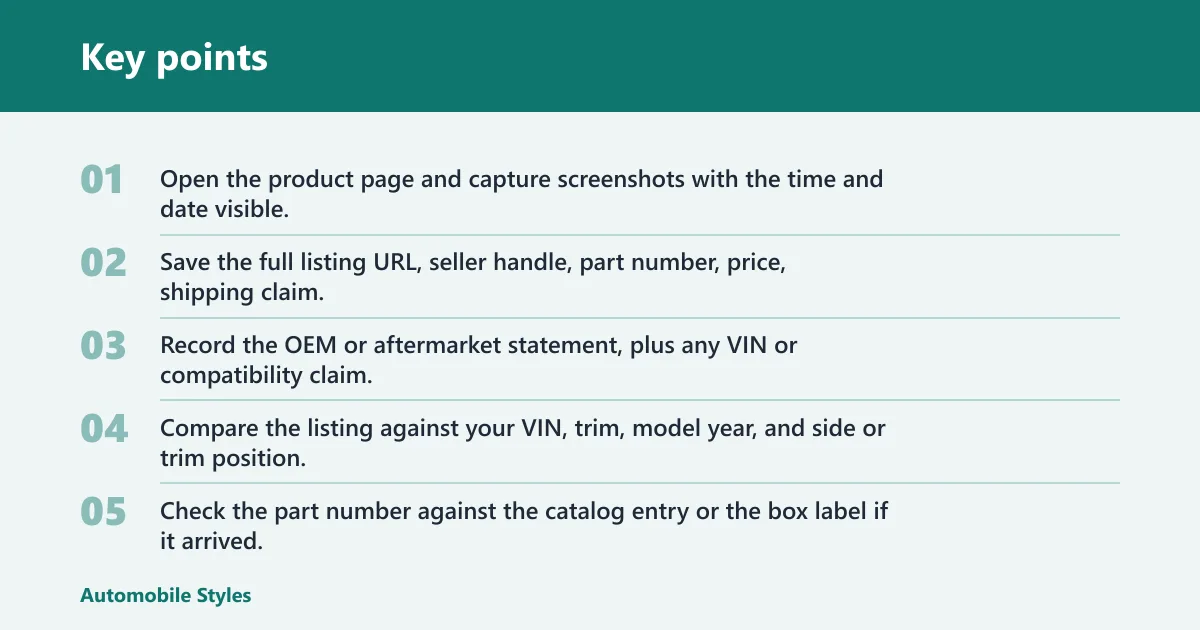
- Open the product page and capture screenshots with the time and date visible.
- Save the full listing URL, seller handle, part number, price, shipping claim, and return policy.
- Record the OEM or aftermarket statement, plus any VIN or compatibility claim.
A deleted page is harder to challenge. Save the seller profile, product title, and every item detail before the platform or seller edits them. If the platform has an evidence-preservation or report flow, use it immediately; major marketplaces such as Facebook/Meta, Shopee, and Lazada provide in-product reporting or help-center dispute paths for scams, counterfeit goods, and order issues.
Step 2: Match the part to your vehicle record
- Compare the listing against your VIN, trim, model year, and side or trim position.
- Check the part number against the catalog entry or the box label if it arrived.
- Mark any bait-and-switch points, such as wrong side, wrong trim, wrong model year, or a counterfeit OEM claim.
Say your listing promised one mirror for a sedan, but the seller shipped a different mirror for a hatchback. That mismatch belongs in the report because it ties the fraud claim to fitment, not just dissatisfaction. For fitment evidence, prioritize the exact vehicle details the seller used, the VIN-based compatibility claim, and the label or part number on the package.
Step 3: Build a time-ordered file
- Save chat logs from Messenger, WhatsApp, Telegram, Viber, or SMS.
- Keep the order confirmation, payment receipt, bank statement, and transfer proof.
- Capture shipping labels, tracking status, refusal notices, and email headers.
Do not delete messages, receipts, or screenshots. A clean timeline helps the platform, the bank, and investigators see what was promised, what was paid, and what actually arrived. Keep one folder for the marketplace, one for the payment dispute, and one for the police or cybercrime complaint so the evidence stays consistent across every channel.
What you’ll need
- Screenshots with visible time and date stamps
- Chat logs from Messenger, WhatsApp, Telegram, Viber, or SMS
- Order confirmation and payment receipt
- Bank statement or e-wallet transfer proof
- Listing URL and seller account handle
- Tracking number, shipping label, and delivery status
- VIN, trim, model year, and the exact compatibility claim
- Email headers for order and shipping messages
- Return policy, refusal notice, or refund denial
Auto parts evidence checklist
| Evidence item | Where to find it | Why it matters | Who gets it first |
|---|---|---|---|
| Listing URL | Browser address bar or saved page | Locks the exact offer before it changes | Marketplace |
| Seller profile and account handle | Marketplace profile or social account page | Ties the offer to a specific account | Marketplace |
| Part number and OEM or aftermarket claim | Product title, description, photos, box label | Shows whether the item matched the stated type | Marketplace |
| VIN or compatibility claim | Listing text, chat thread, compatibility chart | Shows the fitment promise you relied on | Marketplace |
| Order confirmation and payment receipt | Email, app inbox, checkout page, wallet history | Proves the transaction and the amount paid | Payment provider |
| Shipping label and tracking status | Carrier email, parcel label, tracking page | Shows what was shipped, when, and where it stalled | Marketplace |
| Return policy or refusal notice | Listing terms, seller message, support reply | Supports a refund or dispute request | Marketplace |
| Message thread and email headers | Chat export and email details panel | Preserves timing, sender data, and delivery path | Police or cybercrime unit |
Should you report the marketplace first?
Yes. Report the seller on the marketplace or social platform first, because takedown and metadata preservation are easier before the account disappears. Then submit the same evidence set to your bank or wallet fraud desk, and file the external complaint last so every version matches. Most platforms route fraud, counterfeit, and order problems through an in-app report or help-center form, so use that path before the seller can delete messages or edit the listing.
Use the fraud or scam category
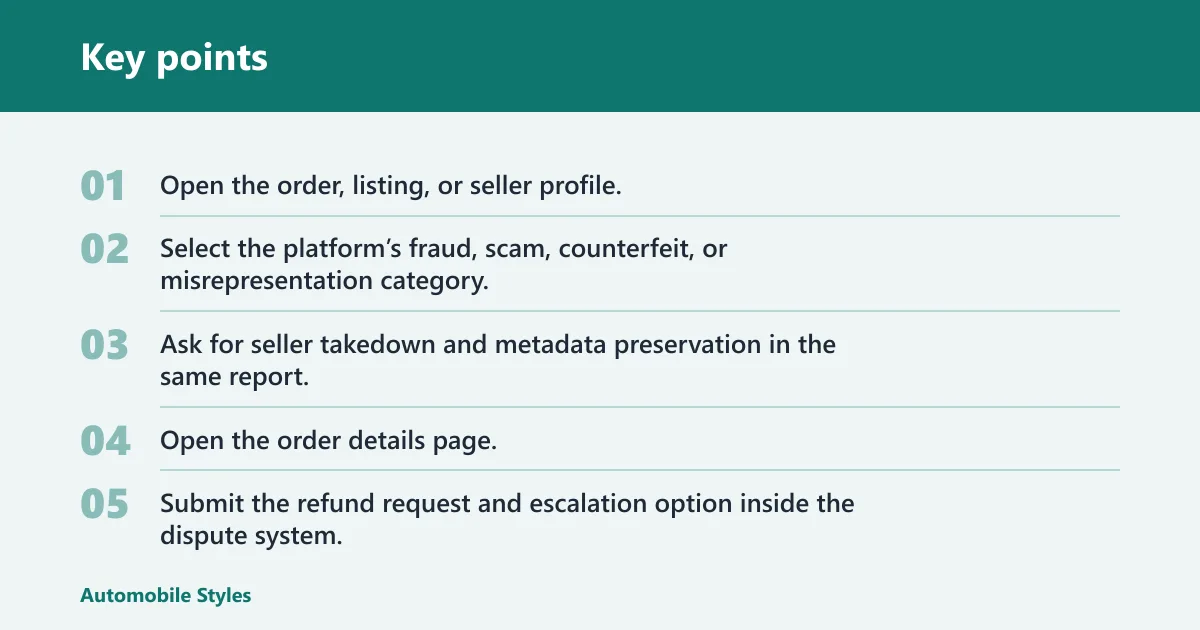
- Open the order, listing, or seller profile.
- Select the platform’s fraud, scam, counterfeit, or misrepresentation category.
- Ask for seller takedown and metadata preservation in the same report.
Facebook and Instagram reporting includes a scam or fraud category. Shopee and Lazada reporting can include seller reports and refund requests. Keep the language consistent: wrong part, wrong fitment, counterfeit claim, or non-delivery. If the marketplace offers a dispute or resolution center, upload the same screenshots, receipt, and tracking details there rather than splitting the record across multiple chats.
Keep the dispute inside the platform flow
- Open the order details page.
- Submit the refund request and escalation option inside the dispute system.
- Attach the screenshots, receipt, and tracking mismatch in one upload.
Suppose the seller promised an OEM bumper cover but shipped a painted aftermarket shell with the wrong mounting points. The platform needs the listing, the shipped item, and the fitment claim in one file, not scattered across separate chats. If the platform has a “return/refund” or “item not as described” path, choose the option that best matches the problem and keep the wording aligned with your payment dispute.
How do you dispute the payment?

Contact your card issuer, bank, or e-wallet fraud desk right away. Choose the route that matches the payment method: card chargeback, bank transfer review, or wallet dispute. State whether the problem was unauthorized payment, misrepresentation, counterfeit goods, or the wrong part. For cards, the relevant network and issuer deadlines can be strict; Visa and Mastercard publish consumer dispute guidance, and your bank may require prompt notice even when the network allows more time.
Credit card
- Call the number on the back of the card or open the issuer’s secure dispute page.
- Choose merchandise not received, not as described, or counterfeit goods.
- Send the listing, receipt, delivery record, and mismatch photos.
Act as soon as you know the part will not fit or is counterfeit. Faster reporting can improve the chance of a hold or investigation. Visa’s cardholder dispute page and Mastercard’s chargeback guidance both stress documenting the issue, contacting the issuer promptly, and using the right reason code for merchandise disputes.
Debit card, bank transfer, or e-wallet
- Open the bank app or call the fraud desk.
- Request an unauthorized transfer review or scam recovery review.
- Send the transaction proof, seller handle, and chat thread.
Bank statements are specifically named evidence to preserve. In the U.S., the Federal Reserve’s Regulation E and the CFPB’s consumer guidance explain the error-resolution process for electronic fund transfers; in the Philippines, e-wallets and banks typically require in-app dispute filing or hotline contact, so use the provider’s official help page or fraud desk immediately. GCash and Maya have in-app fraud reporting, so use the wallet’s dispute channel before the chat trail is lost.
If that didn’t work, escalate
- Ask for a case number and the next review deadline.
- Submit the same file to the marketplace and the cybercrime agency.
- Keep one version of the evidence set for all recipients.
A bank may review the payment while the marketplace checks seller conduct. Those processes are different. The evidence should stay consistent across both. If the issuer asks for a written statement or affidavit, give only the facts needed to show what was advertised, what was paid, what arrived, and why the item is not the one described.
Where do you report the seller offline?
File one primary complaint with the cybercrime or consumer-fraud agency in your area. Attach the written victim narrative, receipts, screenshots, and platform response. If the agency asks, add a sworn statement or affidavit and request a case number or intake confirmation. For the Philippines, use the official intake pages or hotlines for the PNP Anti-Cybercrime Group, NBI Cybercrime Division, or the CICC depending on the complaint route and local availability.
Use one written complaint file
- Write a short timeline with the relevant dates, totals, listing details, and the vehicle fitment claim.
- Attach screenshots, chat logs, order proof, and delivery mismatch photos.
- Include the marketplace response and any refund denial.
The complaint affidavit should read like a sworn statement of facts, not a long complaint letter. Keep it specific: who sold the part, what vehicle it was meant for, what arrived, and what happened after you reported it. If the agency requires a notarized affidavit or sworn statement, follow the intake instructions exactly and keep a copy of the signed filing.
Pick a single agency path
- Choose the main cybercrime route for your case.
- Submit the evidence set once, then follow the intake instructions.
- Keep the case number and investigator contact details in one folder.
In the Philippines, cybercrime complaints can be filed with PNP-ACG, NBI-CCD, or CICC. The PNP-ACG hotline is (02) 8723-0401 loc. 7491. The NBI-CCD hotline is (02) 8523-8231 loc. 5200–5205. The CICC 24/7 hotline listed is 1326. Because hotline numbers and intake steps can change, verify them on the agency’s official website or help page before you call.
Common mistakes
- Deleting chats or original receipts before the report is filed
- Reporting only to the bank and skipping the marketplace
- Leaving out the VIN, part number, or fitment claim
- Sending a long story without dates, totals, and order IDs
- Waiting until the seller edits or removes the listing
- Forgetting screenshots with visible time and date stamps
- Ignoring shipping labels, tracking status, or email headers
A common first-timer mistake is uploading only the payment receipt. That proves a payment happened, but it does not prove the seller promised the wrong part, shipped the wrong side, or used a counterfeit OEM claim. A stronger file includes the marketplace listing, the compatibility claim, the payment trail, and the delivered item or refusal record together.
Frequently asked questions
How do I report an online auto parts store for scamming?
Save the listing, seller profile, chat thread, payment proof, and delivery record first. Then report the seller inside the marketplace fraud category, file the payment dispute, and send the same file to the proper cybercrime agency. Keep the parts mismatch, VIN claim, and part number front and center. If the platform has a formal scam or fraud reporting page, use it before the seller account can be altered or removed.
Where do I report a fake auto parts seller online?
Start on the platform where the sale happened, such as a marketplace or social app. Use the scam or fraud report path, ask for takedown, and keep a copy of the seller handle and listing URL. Then forward the file to your bank or wallet fraud desk. For platform-specific dispute paths, use the marketplace help page or in-app report function rather than a general support email.
What evidence should I collect before reporting an auto parts scam?
Collect screenshots with time and date visible, chat logs, order confirmation, payment receipt, bank statement or transfer proof, shipping label, tracking status, return policy, email headers, and the exact VIN or compatibility claim. Add photos of the wrong, fake, or missing part if it arrived. If the seller used a marketplace compatibility chart, capture that too so the fitment promise is clear.
Should I report the seller to the marketplace or my bank first?
Report the marketplace first, then the bank or e-wallet fraud desk, then law enforcement if needed. The platform can preserve seller metadata and may move faster on takedown, while the bank handles the payment dispute. Use the same evidence set in every report. If your issuer or network gives a shorter deadline than the platform, meet the shorter deadline first.
Can I report an auto parts scam if the seller used Facebook or Telegram?
Yes. Save the profile, handle, chat log, and screenshots before the account disappears. Facebook and Instagram have a scam or fraud category. Telegram messages, SMS, WhatsApp, Messenger, and Viber logs should be exported or captured with timestamps before you file the complaint. For any law-enforcement report, include the chat identifiers and the exact dates of contact.
What if the seller promised OEM parts but sent counterfeit or wrong parts?
Report it as misrepresentation, counterfeit goods, or wrong-item delivery, depending on the platform and payment channel. Keep the OEM claim, part number, fitment statement, and photos of the received part together. That package helps a chargeback, marketplace refund, or police complaint line up. If a sworn statement is required, describe the mismatch plainly and attach the supporting screenshots and labels.
Sources: For payment disputes and timing, see Visa cardholder dispute guidance, Mastercard chargeback rules, the CFPB’s consumer guidance on credit card disputes, and the Federal Reserve’s Regulation E resources. For platform reporting, use the official help or safety pages for Facebook/Instagram, Shopee, Lazada, and your payment provider. For Philippines cybercrime reporting, consult the official PNP-ACG, NBI-Cybercrime Division, and CICC contact pages before filing.