What red flags in an auto parts listing mean it’s a scam?
Treat auto parts listings with about 3 or more red flags, such as wrong fitment details, vague seller identity, a price far below market, or payment-only requests, as a scam until proven otherwise. Ignore them and you can lose money, miss return windows, or end up with a part that never fits. This guide gives you a pre-check that separates normal bargain listings from fraud before you pay.
What counts as a scam listing?
A scam listing is one that you cannot identify, trace, or match to your vehicle with enough confidence to justify payment. A low price alone is not proof of fraud. The better test is whether the listing gives you a real part number, a seller you can verify, and payment terms that leave you recourse if something goes wrong.
Three checks to run first
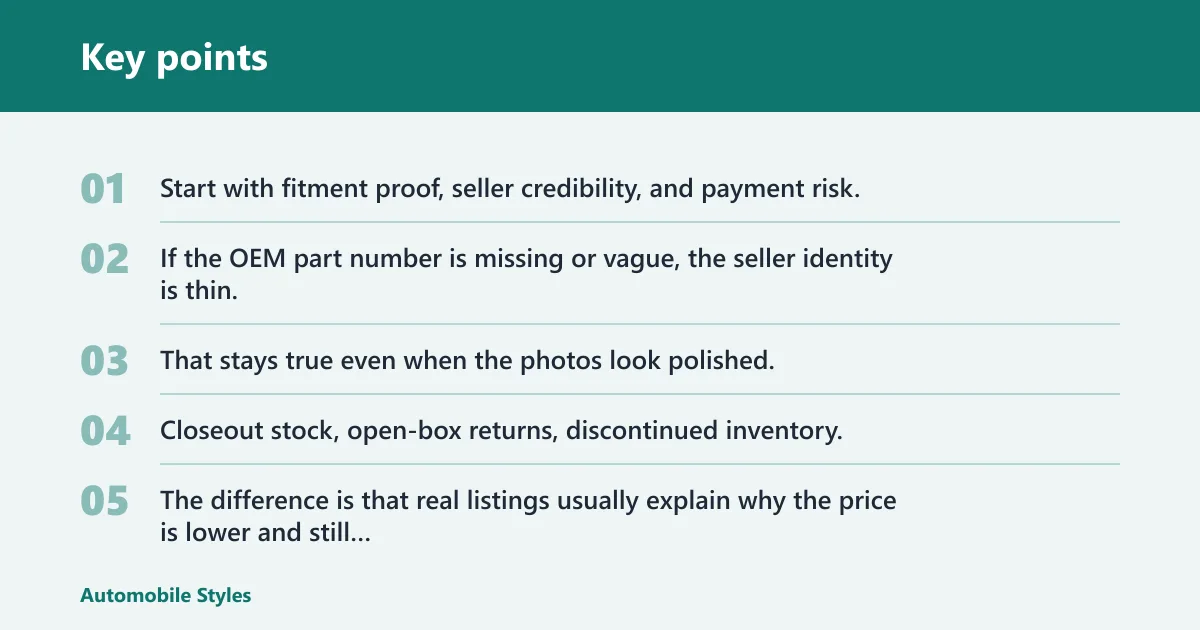
Start with fitment proof, seller credibility, and payment risk. If the OEM part number is missing or vague, the seller identity is thin, and the payment method offers no dispute path, the listing is hard to defend. That stays true even when the photos look polished.
A legitimate bargain can still be a bargain. Closeout stock, open-box returns, discontinued inventory, and used parts can all be priced below normal. The difference is that real listings usually explain why the price is lower and still provide enough detail for you to verify fitment and condition.
When a bargain still looks legitimate
Picture a brake caliper listed at 30% below common retail, with the OEM number in the title, clear photos of the casting, a stated return window, and a seller profile with years of history. That can be a normal clearance listing. The price is low, but the evidence is still there.
| Red flag | Why it matters | How to verify it | Purchase decision outcome |
|---|---|---|---|
| Missing or vague OEM part number | You cannot confirm the exact vehicle application without a match to the catalog or VIN-based lookup. | Compare the number against your vehicle catalog entry or dealer parts catalog, and confirm the suffixes and supersessions. | Keep browsing unless the seller can supply the exact number. |
| Seller identity is thin | Unknown entities are harder to trace if the part is wrong, counterfeit, or never ships. | Look for a business name, legal entity, location, and contact channels that actually connect. | Verify further before buying; abandon if nothing checks out. |
| Price is far below normal with no explanation | That can signal counterfeit stock, salvage origin, or a bait listing. | Compare against multiple sellers for the same part number, not just the same brand name. | Proceed only if the rest of the listing is strong. |
| Payment-only requests off-platform | Irreversible payments leave little room for chargebacks or buyer protection. | Check whether credit card, marketplace protection, or a normal checkout path is available. | Abandon the listing if the seller pushes wire, gift cards, or crypto. |
| Marketplace seller with few reviews and copied photos | Review inflation and copied listings are common fraud patterns. | Check rating volume, account age, listing history, and whether the images match the text. | Verify further or skip the seller. |
| Direct-to-consumer store hides its return terms | Missing return windows or hidden restocking fees can turn a bad fit into a total loss. | Read the return window, exclusions, warranty terms, shipping origin, and tracking policy. | Keep browsing if the policy is unclear. |
| Classified-ad listing has no part number or traceable history | Anonymous sellers and vague descriptions are hard to dispute later. | Ask for the exact number, condition notes, and a payment method with protection. | Walk away if the seller pressures you to move fast or pay irreversibly. |
How do you verify fitment before you pay?
Fitment verification usually starts with the exact OEM part number, then moves to VIN-based confirmation when the part is trim-specific or tied to an option package. Not every legitimate listing will show VIN decoding on the page, but every serious listing should give you enough data to compare against a catalog before checkout.
Match the OEM part number exactly
The OEM part number should match the vehicle application exactly. That number is the cleanest way to verify fitment against a VIN lookup or a parts catalog. Check the title, description, label photo, and packaging image for the same number, including any letters, suffixes, or supersession notes.
If the listing says “fits many models” but gives no part number, treat that as weak evidence. A common first-timer mistake is buying a sensor because the shape looks right, then finding that one connector, bracket, or calibration detail is different.
Use VIN fitment for trim-specific parts
VIN fitment is a verification tool for vehicle-specific compatibility, especially on modern cars with trim-specific electronics, option packages, or mid-year changes. It reduces wrong-part purchases, but the absence of a VIN decoder on the product page is not, by itself, proof of fraud. The key question is whether the seller can verify fitment through a catalog or support channel.
Suppose you are buying a headlight assembly for a trim that offered both halogen and LED versions. A listing that says only “fits 2019 sedan” is not enough. You need the exact application code, connector style, or OEM number before you send money.
Watch for missing compatibility details
A legitimate listing should include clear compatibility notes, condition details, and any known exclusions. For used or remanufactured parts, the seller should state what was rebuilt, what was tested, and whether a core charge applies. For aftermarket parts, the listing should say that plainly instead of implying OEM status.
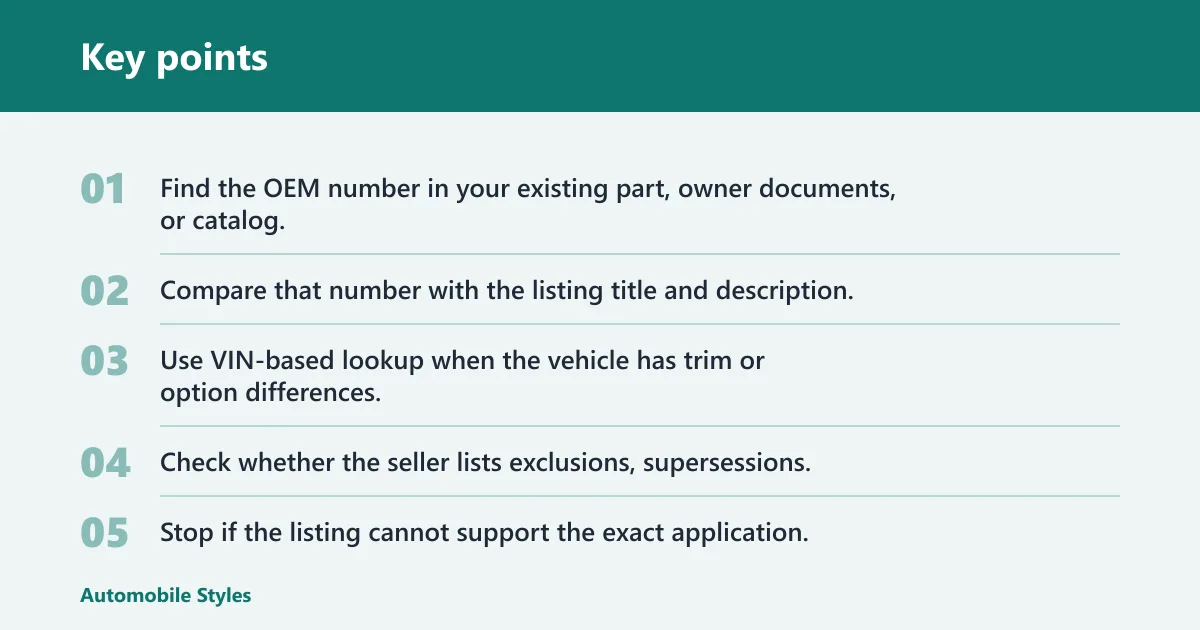
- Find the OEM number in your existing part, owner documents, or catalog.
- Compare that number with the listing title and description.
- Use VIN-based lookup when the vehicle has trim or option differences.
- Check whether the seller lists exclusions, supersessions, or notes about connectors and brackets.
- Stop if the listing cannot support the exact application.
What seller details should you verify?
Seller details should let you identify the business, trace the location, and reach someone who can answer questions before payment. Business name, legal entity, physical address or verifiable location, and working contact channels matter because they make disputes and returns possible. Missing pieces do not prove fraud, but they raise the cost of a mistake.
Business name and legal entity
Check whether the seller names a real business rather than only a screen name. On direct-to-consumer sites, look for the legal entity in the terms, footer, or checkout pages. On marketplaces, a seller profile with a stable name and history is better than a brand-new account with recycled stock photos.
Location and contact channels
A physical address or verifiable location is useful because it tells you where returns, claims, or chargeback records may point. A phone number helps when it works, but a missing phone number alone does not prove fraud. What matters is whether the contact methods actually connect and match the listed business.
Review volume, listing age, and history
On marketplace sellers, check rating volume, review patterns, account age, and whether the photos and text changed between listings. A high score with almost no volume is weak evidence. So is a long account history paired with copied images and a description that does not match the item shown.
What listing clues point to counterfeit or mislabeled parts?
Counterfeit parts, used parts, remanufactured parts, aftermarket parts, and mislabeled parts are not the same thing. A used alternator can be legitimate; a counterfeit alternator can look similar but fail early; a remanufactured part should state that it was rebuilt; an aftermarket part should not be sold as OEM unless the claim is real and authorized.
Logo misuse and misspelled brand names
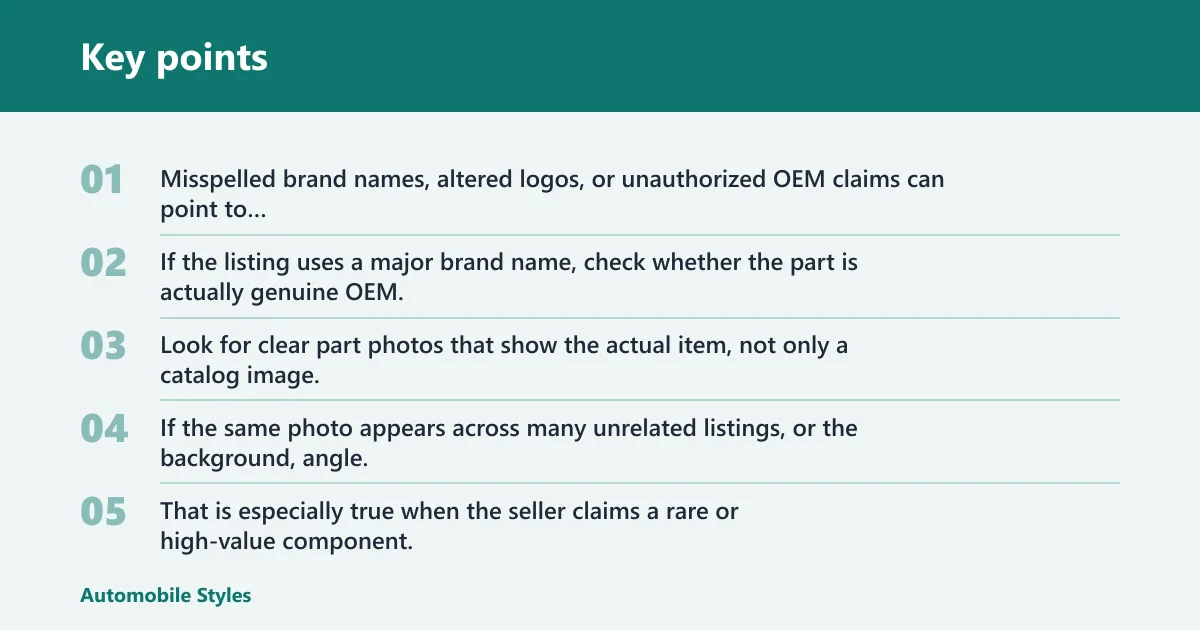
Brand and trademark cues matter. Misspelled brand names, altered logos, or unauthorized OEM claims can point to counterfeit stock or a seller trying to borrow credibility. If the listing uses a major brand name, check whether the part is actually genuine OEM, an approved replacement, or a generic item with a misleading label.
Photo inconsistencies and copied images
Look for clear part photos that show the actual item, not only a catalog image. If the same photo appears across many unrelated listings, or the background, angle, and label do not match the described part, the listing deserves caution. That is especially true when the seller claims a rare or high-value component.
Condition labels that do not fit the part
Condition should make sense for the item. A “new” part with scuffs, dust, and missing packaging is a mismatch. A “used” part described as factory sealed is another mismatch. For remanufactured parts, the listing should explain the rebuild and any warranty limits tied to that condition.
Which payment methods are safest?
Use payment methods that keep dispute rights open. Credit card chargeback rights and buyer-protection services are safer because they give you a path to challenge a bad charge or a non-delivery. Avoid wire transfers, gift cards, crypto, and similar irreversible methods if the listing already shows warning signs.
Credit card dispute rights
A credit card is usually the strongest option because it may support a chargeback if the part never arrives, arrives significantly misdescribed, or is tied to fraud. That does not guarantee recovery, but it gives you a documented path that cash-like methods do not.
Buyer-protection services
Marketplace checkout systems and buyer-protection services can help when the seller fails to ship or sends the wrong item. Read the service rules before buying. Some protections depend on keeping the transaction on-platform, so moving to text messages or an outside payment link can weaken your case.
Payments to avoid
Wire transfers, gift cards, cryptocurrency, and “friends and family” style payments are high-risk when you do not know the seller. If the seller insists on one of these methods, that is a payment-risk red flag on its own. The request matters more than the discount.
How do marketplace, store, and classified listings differ?
Marketplace sellers, direct-to-consumer stores, and classified-ad listings fail in different ways, so the checks are not identical. Marketplace fraud often shows up as review inflation, copied listings, and fake storefronts. Direct-to-consumer store risk often shows up in return policy traps. Classified ads often rely on vagueness and pressure to move off-platform.
Marketplace seller red flags
For marketplace sellers, watch the rating volume, account age, listing age, and consistency between photos and description. A seller with dozens of similar listings, identical photos, and no meaningful history deserves scrutiny. If the listing changes after you ask questions, save the original version before it disappears.
Direct-to-consumer store red flags
For direct-to-consumer stores, read the return window, restocking fees, condition requirements, exclusions, warranty terms, shipping origin, and tracking availability. A site that hides its identity or buries return terms in fine print can turn a simple mistake into a costly one. If the policy is unclear, keep browsing.
Classified-ad red flags
For classified ads, the warning pattern is usually the same: vague description, no part number, no traceable seller history, and pressure to move the deal off-platform. If the seller asks for an irreversible payment method, the risk rises sharply. Classified listings can be legitimate, but they require more verification than a normal storefront.
What should you save before checkout?
Save evidence before paying because a dispute is much easier when you have the original listing in hand. Keep screenshots of the listing, the part number, the compatibility notes, the shipping promise, and the payment page. Save any chat messages that confirm fitment, condition, or return terms.
What to capture
Save the listing title, price, seller name, product photos, and all compatibility text. Capture the return policy, warranty language, shipping origin, and tracking claims. If the seller gives a different number or changes the description later, your saved copy shows what you agreed to buy.
Why records matter
Those records help if you need to dispute the charge or report the seller to the marketplace, card issuer, or payment service. They also help if the part arrives and the box shows a different brand, condition, or application than the listing promised.
What are the biggest red flags in an auto parts listing?
The biggest red flags are missing fitment proof, weak seller identity, and payment methods that remove your ability to dispute the charge. Add in copied photos, inconsistent condition notes, and a price that is far below normal without explanation, and the listing deserves a hard pause before checkout.
How can I tell if an online parts seller is fake?
Look for a seller that cannot be traced to a real business name, location, or functioning contact method. Fake sellers also tend to have thin review history, copied images, and descriptions that do not match the photos. If the account pushes off-platform payment, the risk climbs fast.
Is a price that is way below normal always a scam?
No. A very low price can reflect clearance stock, used condition, remanufactured status, or an open-box return. It becomes suspicious when the listing cannot explain the discount and fails the other checks: exact part number, believable seller identity, and safe payment terms.
What should a legitimate auto parts listing include?
A legitimate listing should include the OEM part number, clear photos of the actual item, complete compatibility notes, honest condition details, and a return policy that you can read before paying. Seller identity, shipping origin, and tracking information should also be visible or easy to verify.
How do I check part numbers before I buy online?
Compare the OEM number on the listing with the number tied to your vehicle in a catalog, dealer parts listing, or VIN-based lookup. Check every character, including suffixes and supersessions. If the seller cannot confirm the exact application, do not assume the shape alone is enough.
What payment method should I use if I suspect a scam?
Use a credit card when possible because dispute rights are stronger than with cash-like methods. Buyer-protection services are the next best choice if the platform supports them. Avoid wire transfers, gift cards, cryptocurrency, and off-platform payments that cannot be reversed.