LED headlights vs halogen: Which is better for night driving?
LED headlights are usually the better night-driving choice when the beam pattern is tightly controlled; pick them over halogen for wider, whiter light on dark roads, but stay with good halogen if the LED setup adds glare or scatter. A poor headlight choice can shorten visible stopping distance, blind oncoming drivers, and make rain or fog harder to read. This guide compares beam control, wet-weather performance, glare risk, and retrofit pitfalls so you can choose the safer setup.
| Decision factor | LED headlights | halogen | Winner |
|---|---|---|---|
| Beam control in the right housing | Strong when the source position matches the optic and the driver module is designed for the lamp | Strong in the housing it was designed around | Tie |
| Usable night-driving reach | Usually better down-road reach when the beam is well controlled | Often softer and less far-reaching, but can be very usable in a proper optic | LED headlights |
| Rain and fog behavior | Can create more foreground glare and backscatter if the beam is too high or too white | Warmer light is often easier to manage in moisture-heavy conditions | halogen |
| Glare risk from a bad retrofit | High if a drop-in bulb is used in a reflector or mismatched projector | Lower when kept stock in the original housing | halogen |
| Power draw | Lower typical draw | Higher typical draw | LED headlights |
| Replacement cost over time | Often higher if a full assembly or driver module fails | Usually cheaper for bulb-only swaps | halogen |
LED headlights vs halogen: the real trade-off
The real choice is not “bright versus dim.” It is controlled beam pattern versus uncontrolled glare, plus the cost of getting that beam pattern right. LED headlights can deliver more usable road light when the housing is designed for them, while halogen often stays safer and simpler in older or reflector-based setups.
What each bulb changes at night
Halogen uses a tungsten filament that glows when current passes through it. The common setup is about 55W, around 1000 lumens, and a warm color near 2700K, which many drivers find easier to read in wet weather and on dirty roads.
LED headlight bulbs use a semiconductor light source with driver electronics and heat management. Typical draw is around 20W, with output often listed at roughly 3000 to 6000 lumens and a color range of 4300K to 6000K. Those numbers help, but only if the beam lands where the road needs it.
Why optics decide the outcome more than brightness claims
A headlight housing shapes the beam. Reflector bowls, projector lenses, cutoff shields, and the exact position of the light source decide whether the road gets a clean cutoff or a spray of stray light.
That is why a brighter bulb can still drive worse. A source that sits a few millimeters off the intended focal point can throw light above the cutoff, into oncoming eyes, or into the foreground where it washes out distance vision.
How halogen and LED headlights make light
Halogen and LED headlights create light in very different ways, and those differences affect heat, lifespan, and how the optic sees the source. The bulb is only one part of the system. The housing, reflector, projector, and lens do much of the safety work.
Halogen filament basics
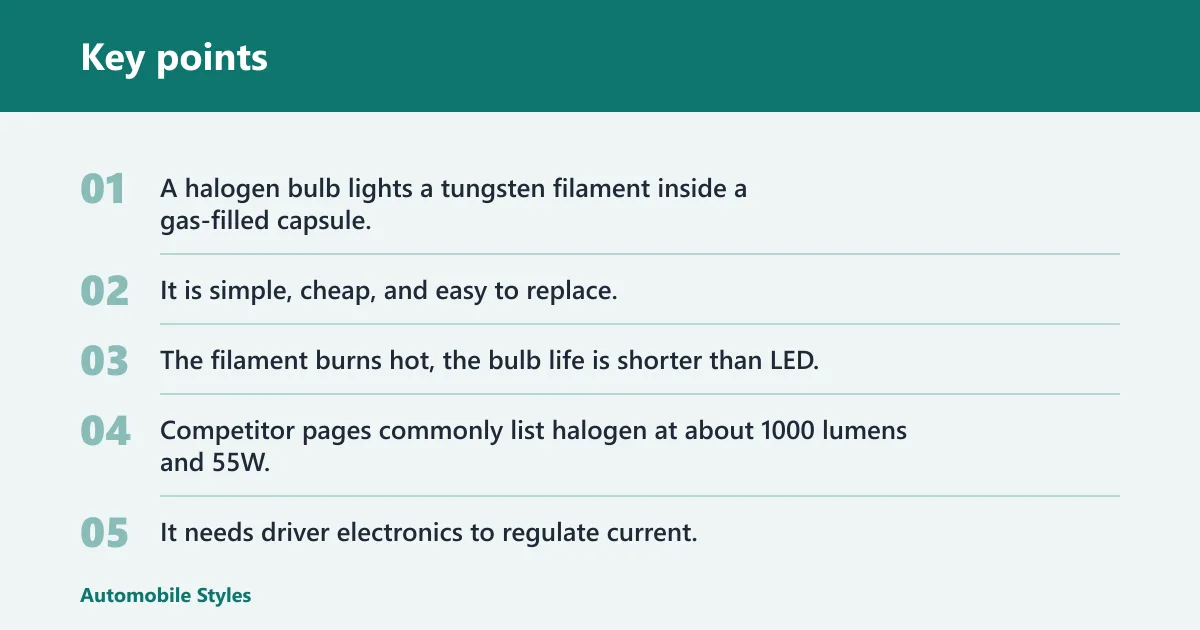
A halogen bulb lights a tungsten filament inside a gas-filled capsule. It is simple, cheap, and easy to replace, which is why stock halogen remains common in many cars and trucks.
That simplicity has a cost. The filament burns hot, the bulb life is shorter than LED, and the light is usually warm and lower in output. Competitor pages commonly list halogen at about 1000 lumens and 55W, with lifespan of only 500 to 1000 hours.
LED source, driver, and cooling needs
An LED bulb is not just a chip. It needs driver electronics to regulate current, plus a thermal path that moves heat away from the emitter. Many retrofit bulbs use a heat sink, and some add a cooling fan.
If heat is not managed well, output can sag and electronics can fail early. That is why the claimed theoretical lifespan exceeding 50,000 hours does not guarantee real-world durability in every installation.
Typical output, color, and power draw
LEDs are often sold with higher brightness claims and a whiter color.
Those figures explain the appeal, but they do not settle the question. The safer setup is the one that keeps the cutoff sharp, the foreground calm, and the road lit at useful distance.
Which light gives better night-driving visibility?
LED headlights usually give better night-driving visibility when the beam is correctly aimed and the source position matches the housing. They can improve road reach, sign readability, and lane marking contrast. Halogen can still be easier on the eyes in some optics, especially if the LED setup throws stray light or overlights the hood and foreground.
Distance illumination and road reach
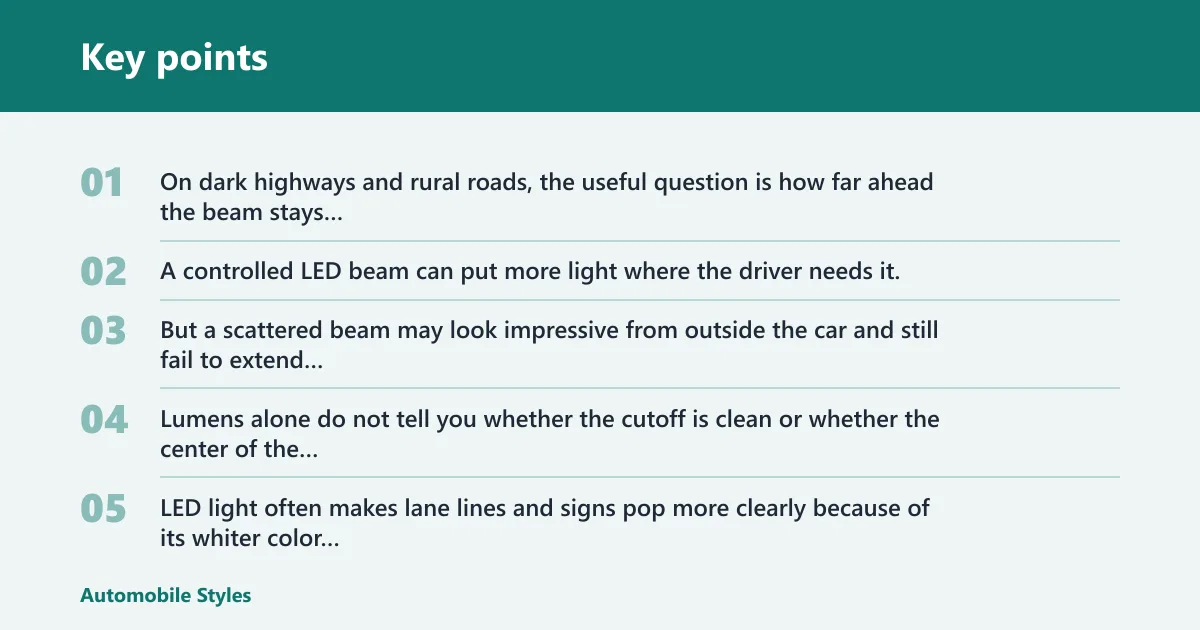
On dark highways and rural roads, the useful question is how far ahead the beam stays organized. A controlled LED beam can put more light where the driver needs it, which helps identify curves, animals, or debris sooner.
But a scattered beam may look impressive from outside the car and still fail to extend useful reach. Lumens alone do not tell you whether the cutoff is clean or whether the center of the beam is where the road needs it.
Lane markings, signs, and foreground light
LED light often makes lane lines and signs pop more clearly because of its whiter color and stronger output. That helps when the road surface is dry and the optic is correct.
Too much foreground light can work against long-distance vision. If the first few dozen feet are too bright, the eyes can adapt to the near field and distant hazards may become harder to read.
Glare control and driver fatigue
Glare is not only an issue for other drivers. It also makes the driver’s eyes work harder, especially on long night drives. A good headlight keeps light below the cutoff and avoids bright spill that bounces off mirrors, signs, wet paint, or the hood.
That is one reason a well-designed halogen beam can feel calmer than a poorly matched LED retrofit. Less glare often means less fatigue.
Suppose a driver commutes about 35 miles each way on a dark two-lane highway. A clean LED projector beam can improve sign pickup and animal detection, but a drop-in LED in a reflector may light the trees and not the lane. The same road, same speed, and same car can produce very different safety outcomes.
Headlight optics and beam pattern
Headlight optics matter more than bulb type alone because they decide where the light goes. Reflector housings are sensitive to source shape and position. Projector housings are more forgiving, but they still need the right focal point and cutoff geometry.
Reflector housings versus projector housings
Reflector headlights rely on the bulb’s filament or emitter sitting at a precise point so the bowl can throw light in the intended pattern. Swap in a source with a different size or geometry, and the beam can break apart.
Projectors use a lens and shield to create a tighter cutoff. They can work better with LED in the right design, but they are not immune to mismatch.
Source position sensitivity
LED emitters are usually laid out differently from a halogen filament. Even a small offset can shift the focal point and change the cutoff, hotspot, and side spill.
That is why “fits the socket” is not the same as “fits the optic.” A bulb can install cleanly and still perform badly on the road.
Why a retrofit can fail in the same housing
A drop-in LED retrofit in a halogen housing can create scattered light, glare, and beam lift. The problem is not only brightness. It is the mismatch between the light source and the reflector or projector design.
One common warning is that direct bare LED bulb replacement can cause severe scattered light. Some pages claim over 90% of such retrofits fail official inspections. That is the kind of risk that makes a full LED assembly a better path than a random bulb swap.
How do rain, fog, and snow change the answer?
Wet weather changes the target. Rain, fog, and snow scatter light back toward the driver, so the best beam is not simply the brightest one. Warm halogen light often stays easier to manage in heavy moisture, while cooler, whiter LED light can increase reflection and foreground glare if the beam is not tightly controlled.
Scatter and reflection off moisture
Water droplets and snow crystals send light in many directions. A high-output beam can bounce back into the driver’s eyes and reduce contrast, especially close to the car.
That means “more light” can become “less useful light” in bad weather. A controlled beam with less spill often matters more than a high lumen claim.
Warm halogen light versus cooler LED light
Halogen’s warmer color can feel more comfortable in mist and rain because it is less harsh on wet surfaces. It is not magic, and it does not pierce fog by itself, but it can be easier to interpret when the road is reflective.
LED headlights can still work well in rain or fog if the beam is well aimed and the housing is designed for them. The problem appears when the beam is too high, too white, or too diffuse.
A common first-timer mistake is assuming a 6000K retrofit will automatically help in fog because it looks “clearer.” If the beam is broad and uncontrolled, the driver gets more wall-of-light reflection and less usable road texture. The issue is not the color alone; it is how the optic handles that color and source.
LED headlights decision matrix
This matrix scores the common driving situations that matter most. The point is not to crown one technology for every car. It is to match the lamp to the housing, weather, and ownership pattern.
| Scenario | LED headlights score | halogen score | Recommended pick | Short reason |
|---|---|---|---|---|
| City commuting | 4/5 | 3/5 | LED headlights | Better sign and lane contrast if glare is controlled |
| Highway driving | 5/5 | 3/5 | LED headlights | Longer useful reach matters most here |
| Rural roads | 4/5 | 4/5 | Tie | Depends heavily on housing design and beam shape |
| Rain and fog | 3/5 | 4/5 | halogen | Warmer light and lower glare are often easier to live with |
| Older headlamp housings | 2/5 | 4/5 | halogen | Stock halogen is usually safer in aging optics |
| Retrofit risk and cost | 2/5 | 5/5 | halogen | Lower risk, lower cost, fewer compatibility problems |
City commuting
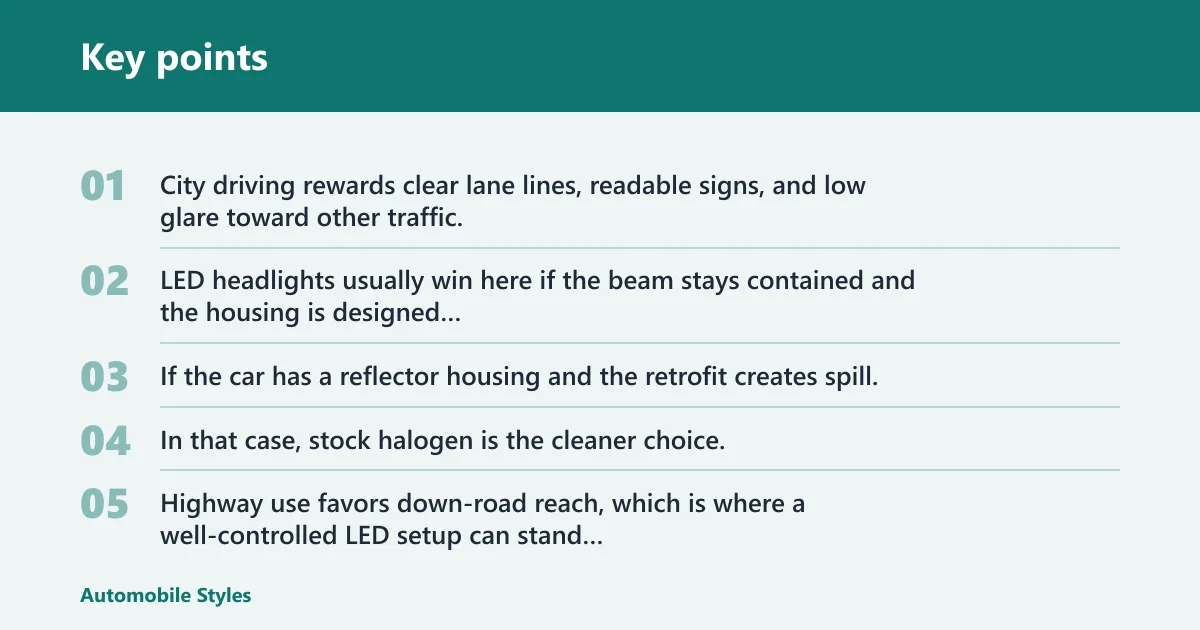
City driving rewards clear lane lines, readable signs, and low glare toward other traffic. LED headlights usually win here if the beam stays contained and the housing is designed for them.
If the car has a reflector housing and the retrofit creates spill, the advantage disappears fast. In that case, stock halogen is the cleaner choice.
Highway driving
Highway use favors down-road reach, which is where a well-controlled LED setup can stand out. The driver benefits from earlier detection of distant objects and roadside hazards.
That said, if the beam throws too much foreground light or creates hot spots, the extra output is wasted. A bad LED setup can be worse than a good halogen one.
Rural roads
Rural driving often mixes darkness, curves, animals, and uneven pavement. That makes beam pattern more important than raw brightness.
LED headlights and halogen can both work well here. The winner is usually the one that matches the housing design, not the one with the larger lumen number.
Rain and fog
In moisture-heavy weather, halogen often has the edge because its warmer output can be easier to manage and less harsh in reflections. This does not mean LED fails automatically, only that the margin for error is smaller.
When glare and scatter matter more than distance, the simpler halogen beam often feels calmer and safer.
Older headlamp housings
Older housings can have hazed lenses, tired reflectors, or uneven optics. Those problems magnify any mismatch between source and housing.
In that setting, halogen is usually the safer answer until the assembly itself is repaired or replaced. A new bulb cannot fix a worn optic.
Retrofit risk and cost
Bulb-only halogen replacement is usually cheap and simple. LED retrofits can be cheap on the sticker, but the hidden cost is fitment, heat management, inspection risk, and possible glare.
Complete LED assemblies cost more up front, yet they often make more sense when the optics are designed around the LEDs from the start.
Choose LED headlights if… / Choose halogen if…
Choose LED headlights if your car has an LED-ready projector or complete LED assembly, you drive dark highways often, you want stronger lane and sign contrast, and the beam remains clean with low glare. LED also fits drivers who want lower power draw and are willing to pay more up front for the right hardware.
Choose halogen if your car has an older reflector housing, your main concern is rain or fog, your budget favors cheap bulb-only replacement, or a retrofit would risk glare and inspection trouble. Halogen is also the safer default when the headlamp lens or reflector is already worn.
If neither bulb swap solves the problem, the right fix is the housing itself. A damaged optic, weak projector, or cloudy lens needs repair before any bulb technology can work properly.
Frequently asked questions
Are LED headlights actually better than halogen for night driving?
Usually yes, but only when the optics are correct. LED headlights can put more useful light farther down the road, improve sign and lane contrast, and reduce power draw. A poor retrofit can lose that advantage through glare, scattered light, or a bad cutoff.
Do LED headlights improve visibility in rain and fog compared with halogen?
Not automatically. Moisture scatters light, so a whiter, higher-output beam can create more reflection back at the driver if the pattern is not tight. Halogen’s warmer output often feels easier to manage in wet weather, especially in older housings.
Can a halogen headlight housing work safely with LED bulbs?
Sometimes, but only if the bulb is engineered for that housing and the beam pattern stays controlled. Many drop-in LED retrofits change the source position enough to create glare or scattered light. A socket fit does not prove optical fit.
Why can an LED bulb look bright but still not light the road better?
Because brightness at the bulb is not the same as useful light on the pavement. If the emitter sits in the wrong position, the reflector or projector cannot shape the beam correctly. The result can be more foreground glare and less distance reach.
Which headlights are cheaper to replace over time, halogen or LED?
Halogen is usually cheaper for bulb-only replacement. LED can cost less in power and may last longer, but full assemblies, driver modules, heat sinks, and repair complexity often raise long-term cost. The cheapest ownership path depends on whether you are replacing a bulb or an entire unit.
Do LED headlights use less power than halogen bulbs?
Yes, in most common setups. Competitor listings often put halogen around 55W and LED around 20W. That lower draw is real, but it should stay a secondary factor behind beam quality, glare control, and housing compatibility.
What beam-pattern problems happen when you retrofit LED bulbs into halogen headlights?
Common problems include cutoff lift, scattered light, hot spots, and glare into oncoming traffic. Reflector housings are especially sensitive to the LED source position, and even projector housings can fail if the emitter does not sit where the optic expects it.
Are halogen headlights still the better choice for some drivers?
Yes. Halogen is often the better answer for older housings, wet climates, tight budgets, and any car where a drop-in LED would create glare or inspection risk. It is also a sensible choice when the vehicle’s original optic was tuned around a tungsten filament.